Fall/Winter 2026 Embellishment Trends: What Is Actually Changing?
New to Luneville embroidery?
Start with the chain stitch—my free visual guide shows you exactly how
If Spring/Summer 2026 was largely about familiar motifs being reworked through placement and scale, Fall/Winter 2026 looks different. This season, the surface itself is getting much more attention.
Embroidery, beads, sequins, paillettes, fringe, pearls, brocade and three-dimensional decoration appear across the collections, but not only where we expect to see them. They are moving beyond evening dresses and into denim, jackets, bags, shoes and other everyday pieces.
That is probably the most useful thing to take from the season.
For several years, fashion has been dominated by restrained styling, minimal surfaces and the endless discussion around “quiet luxury”. Fall/Winter 2026 does not abandon simple clothes, but it gives them much more to say. Vogue describes the season as a shift from understated dressing towards richer textures and unexpected details, while Who What Wear goes considerably further, identifying heavy embellishment as one of the season’s major trends.
The techniques themselves are obviously not new. What is changing is how much visual space they are given, what they are applied to, and how readily a heavily decorated piece is mixed with an otherwise ordinary wardrobe.
These are the Fall/Winter 2026 trends I find most relevant from an embellishment point of view.
Art Decadence
The 1920s appear repeatedly across Fall/Winter 2026, but the useful reference here is not simply the return of the flapper dress.
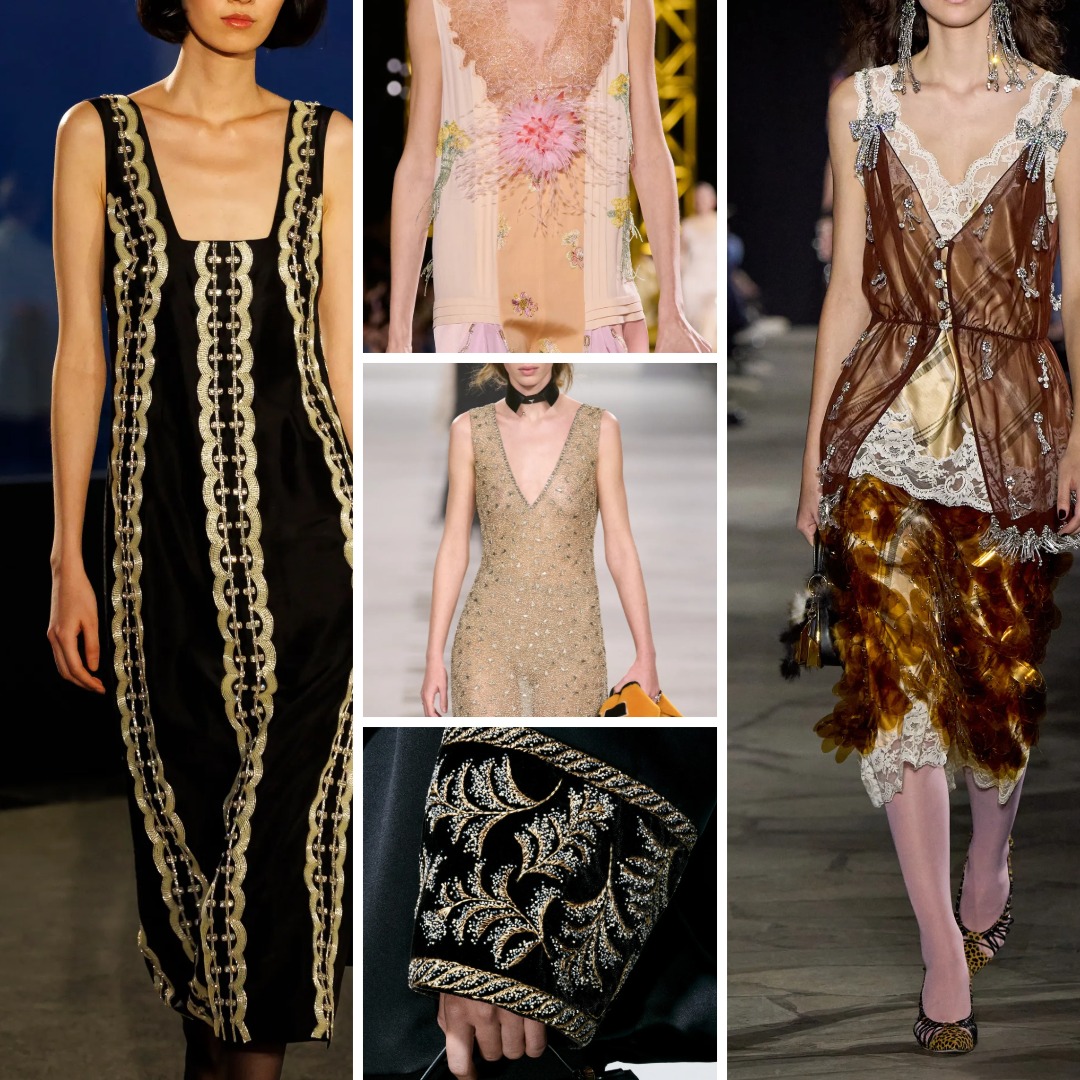
Designers are using the decorative language associated with Art Deco: geometric structures, repeated linear elements, fringe, beads, metallic surfaces and richly decorated evening pieces. Vogue identifies Art Deco as one of the major Fall 2026 directions, with examples at Fendi, Chanel, Rabanne and others.
Kallmeyer gives a particularly clear example of how this translates into embellishment. Hand-stained bugle beads are arranged into lattice embroidery across trousers and a flapper-style dress, taking the geometry of Art Deco architecture directly onto the textile surface.
Bugle beads are especially suited to this type of design because they form a line rather than a point. Repeated in different directions, they can build grids, rays, angles and architectural patterns without relying on a printed motif underneath.
Fringe works differently but belongs to the same visual language. It adds movement to an otherwise static decorative surface, which is one reason it appears so frequently in 1920s references.
What makes the trend relevant beyond the runway is that the complete historical look is not necessary. A beaded panel, fringed hem, geometric evening bag or decorated shoe is enough to carry the reference. We are already seeing the Art Deco direction move from runway styling into current Fall 2026 fashion and accessory coverage.
Boho Revival
Boho itself is not new for Fall/Winter 2026. It has been building for several seasons.
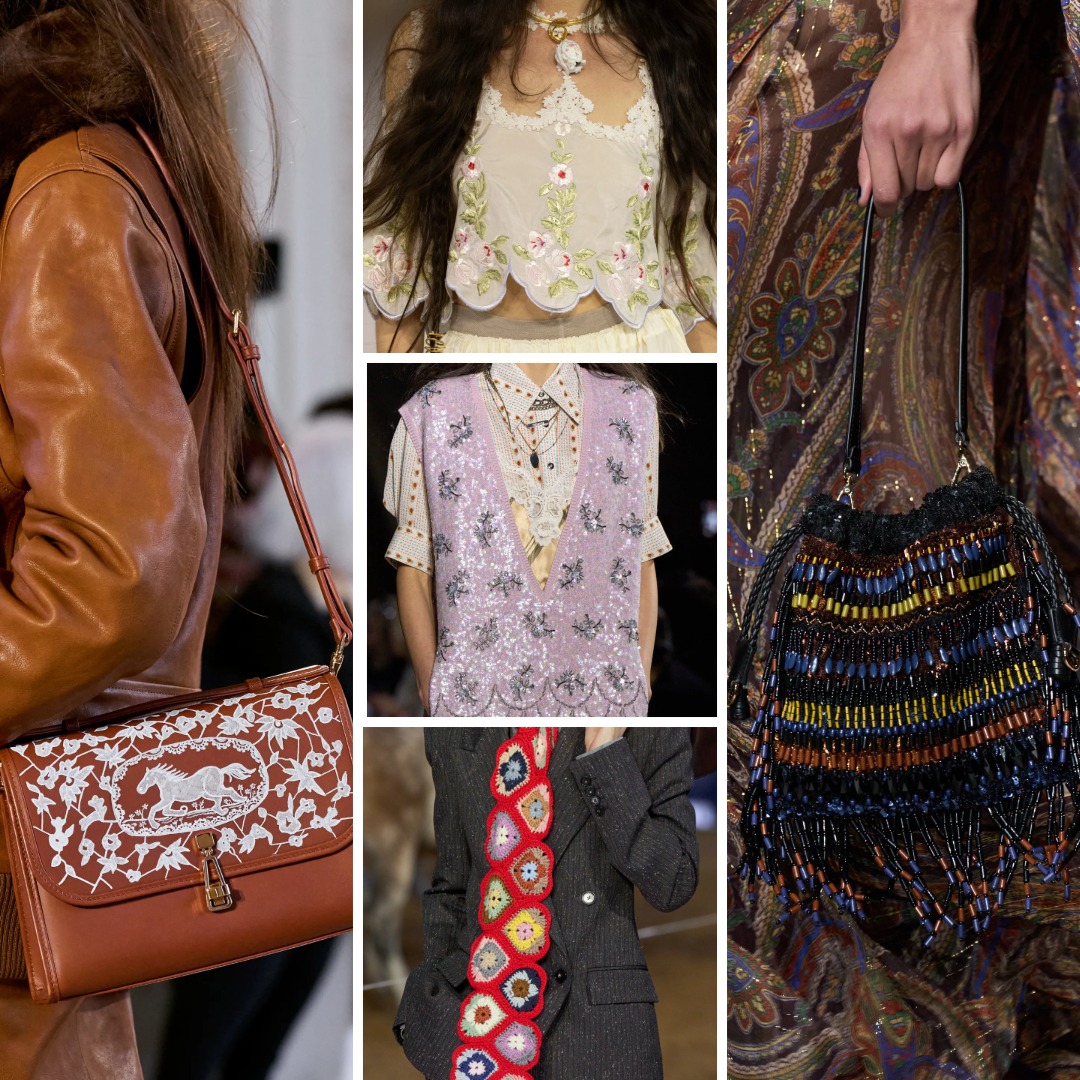
What has changed is the surface.
The lighter, romantic version of boho is becoming darker and more substantial, with leather, fringe, tassels, embroidery, heavier textiles and obvious folk references appearing together. Who What Wear describes the Fall/Winter 2026 version as darker, more textured and more gothic than the earlier revival.
This is particularly visible in accessories. Valentino’s embroidered fringed bags combine floral textile surfaces with long fringe, tassels, visible stitching and leather. Instead of using one decorative detail, several are layered together.
Chloé approaches the same direction through references to folk clothing and garments made to be passed between generations. The important part for embellishment is not whether every piece is literally handmade. It is the deliberate use of techniques and materials associated with textile handwork: embroidery, stitching, yarn, fringe and constructed decorative details.
This also explains why accessories are so important to the commercial side of the trend. A highly decorated bag can bring the whole boho language into a plain outfit without requiring the customer to dress head to toe in it.
Bloom Service
Flowers are hardly a new fashion trend, so “florals are back” tells us very little. What is different in Fall/Winter 2026 is the way flowers are being made.
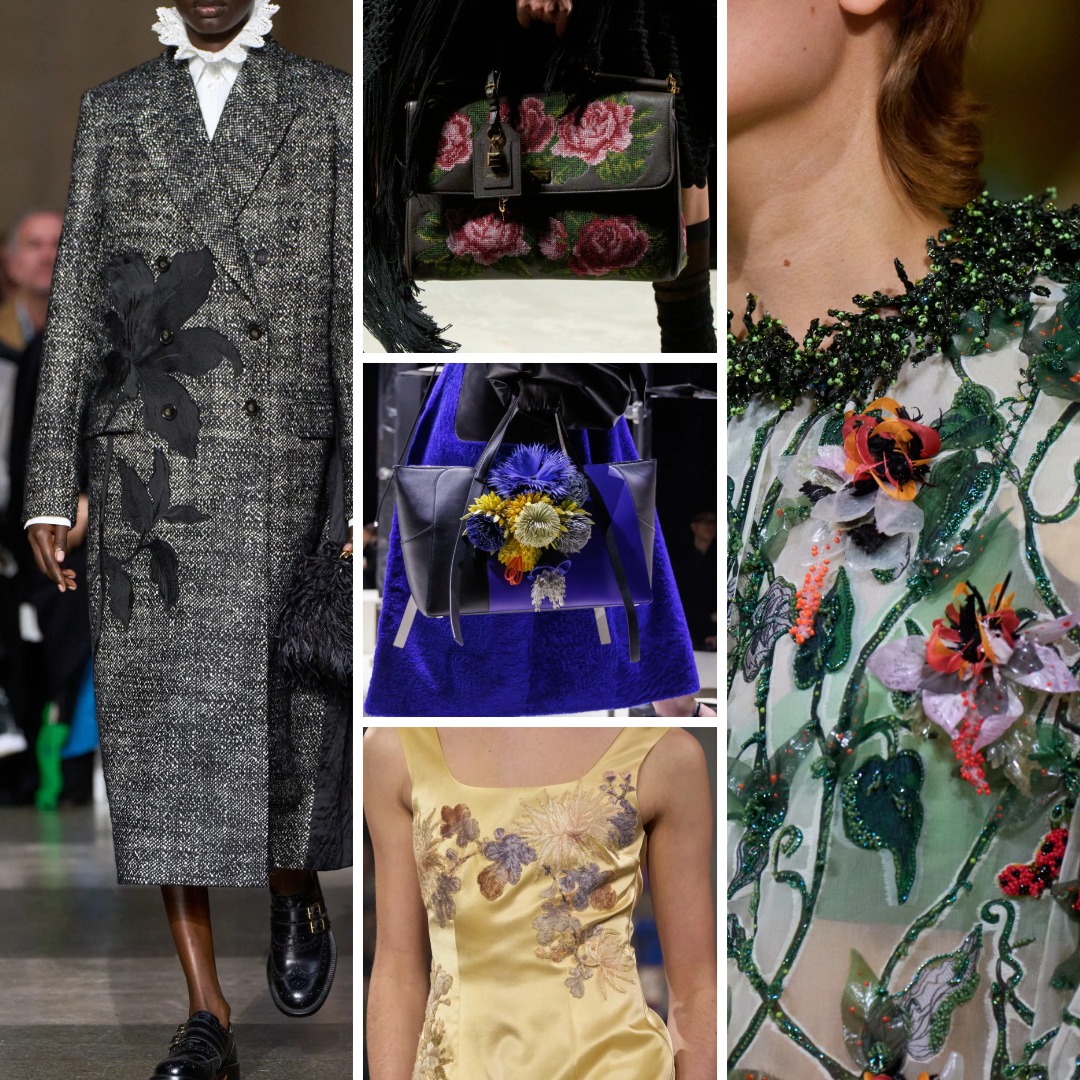
Across the collections, florals move away from being only a printed image and appear through embroidery, tapestry-like surfaces, brocade, appliqué and three-dimensional decoration.
Conner Ives uses richly embroidered floral textiles; Givenchy presents embroidered hydrangeas; floral surfaces also appear across Erdem, Chanel and other collections. Who What Wear groups this kind of elaborate floral textile treatment together as a distinct Fall/Winter 2026 direction.
The accessories market makes the shift even easier to see. ELLE identifies Embroidery and Needlepoint as one of the five major Fall 2026 bag trends, pointing specifically to floral embroidery at Dolce & Gabbana, Valentino, Givenchy and Loro Piana.
That matters because the flower itself has not changed. The method has.
A printed flower remains visually on the surface. Embroidery introduces thread direction and relief. Beads and paillettes react differently to light. Appliqué can lift parts of the motif away from the base fabric altogether.
The floral brooches appearing across Fall 2026 push the same idea even further. The flower is no longer simply represented on the textile; it becomes a separate object attached to the garment.
This is quite a logical continuation of what happened in Spring/Summer 2026. In that season, floral embellishment was often concentrated into specific areas rather than repeated as an all-over pattern. For Fall/Winter, those floral surfaces become heavier, richer and much more physical.
Fully Loaded
If I had to choose one trend that best describes Fall/Winter 2026 embellishment, it would be this one.
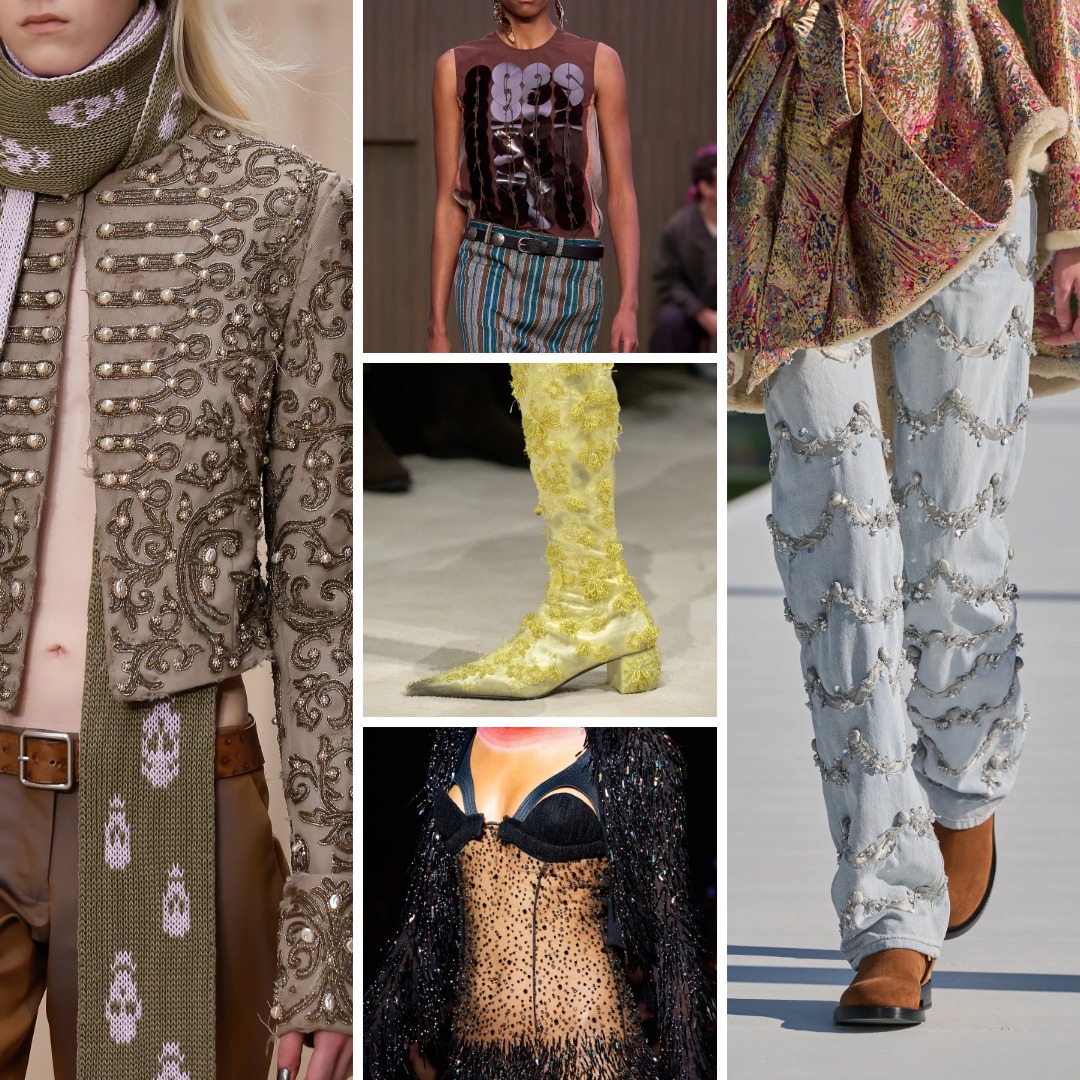
Who What Wear calls it Fully Loaded, grouping together beads, sequins, paillettes, chainmail, fringe, feathers and intricate embroidery. Examples include embroidered work at McQueen, hand-appliquéd paillettes at Marni and cascading three-dimensional beadwork at Prada.
The important part is not simply that there is “a lot” of embellishment.
Several techniques are being used to change the physical surface of the garment. Paillettes overlap. Beads hang away from the fabric. Fringe moves. Pearls and appliquéd elements create relief. Decoration is not always treated as a flat motif stitched onto cloth.
Naeem Khan takes this to an obvious extreme, concentrating on the beading and embellishment for which the label is known and deliberately pushing it further for Fall 2026.
But the much more interesting change is where this decoration is appearing. It is not confined to eveningwear.
Marie Claire identifies embellished denim from Etro, Conner Ives and Stella McCartney as one of its Fall 2026 denim directions. Miu Miu showed athletic shoes covered with beads and sequins. Fendi has reworked its established Baguette shape with dense embroidery and kaleidoscopic beadwork.
That gives the trend a much broader market than an embellished evening dress ever could.
A customer can wear embroidered jeans with a plain knit, carry one densely beaded bag, or put an embellished shoe under otherwise straightforward clothes. The decoration becomes the focal piece rather than requiring the entire outfit to be decorative.
This is where I think the shift away from quiet luxury becomes most visible. The simple garment has not disappeared. It is increasingly being used as a background for something much more worked.
Sheer Delights
Sheer fabric is obviously not an embellishment technique, but it is particularly relevant this season because designers are repeatedly using transparency together with surface decoration.
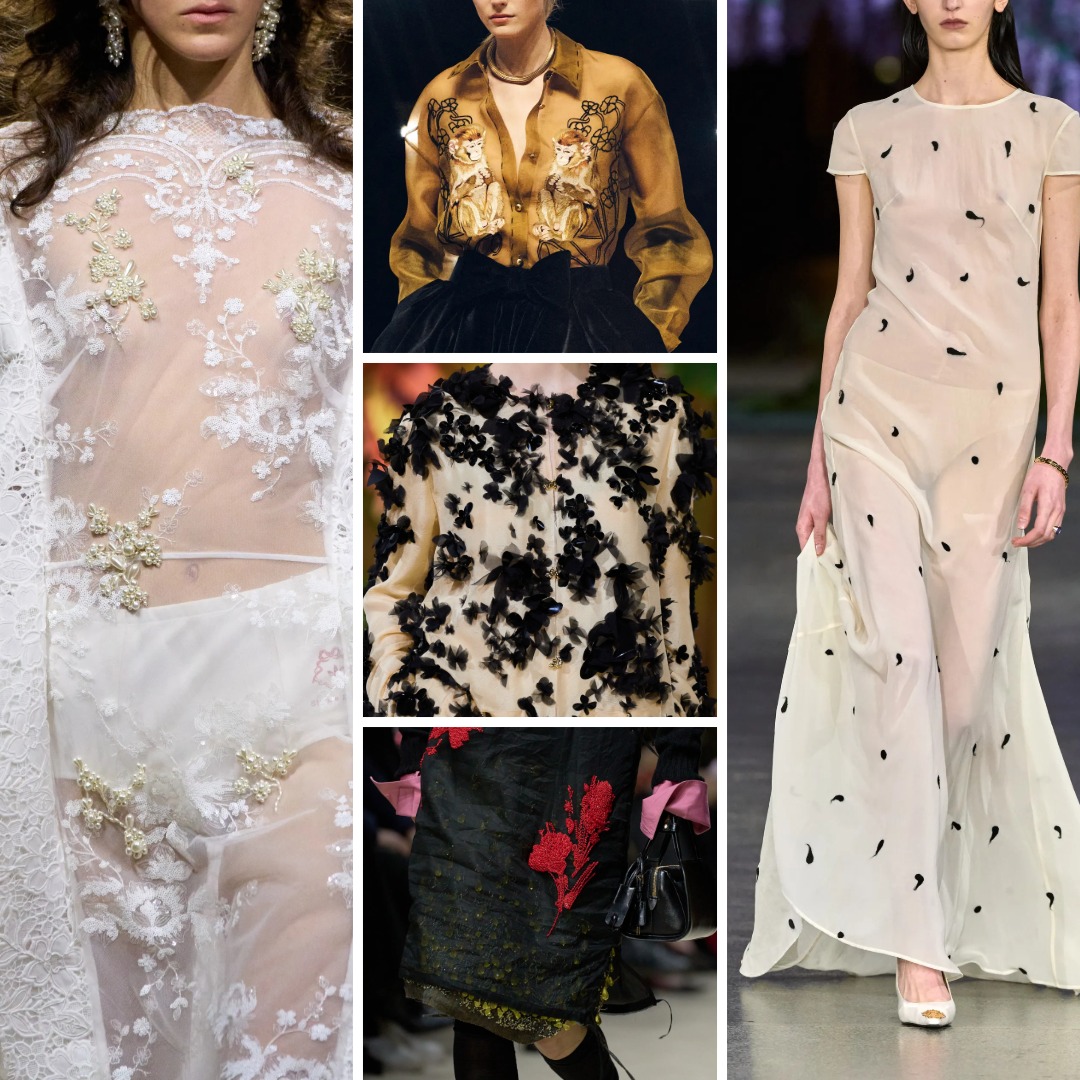
Who What Wear identifies layering of translucent fabrics as one of the major Fall/Winter 2026 trends, while Vogue points to Caroline Hu embedding roses in mesh and Ann Sophie Madsen embedding jewels into transparent material.
This changes the way embellishment is seen.
On an opaque textile, the fabric remains a visible part of the composition. On tulle, mesh or very light organza, that ground can almost disappear. Individual decorative elements appear to sit directly on the body or float above another layer of clothing.
It also makes empty space much more important.
The embellishment does not need to fill the entire surface. A transparent ground allows isolated beads, flowers, embroidery or appliquéd elements to remain visibly separate while still belonging to the same composition.
This is why the Fall/Winter 2026 use of sheer fabrics is more interesting from an embroidery point of view than transparency alone. The fabric becomes part of the construction of the surface rather than simply a way of showing skin.
Picture Perfect
Picture Perfect sits slightly outside traditional embellishment, but I think it belongs in this discussion.
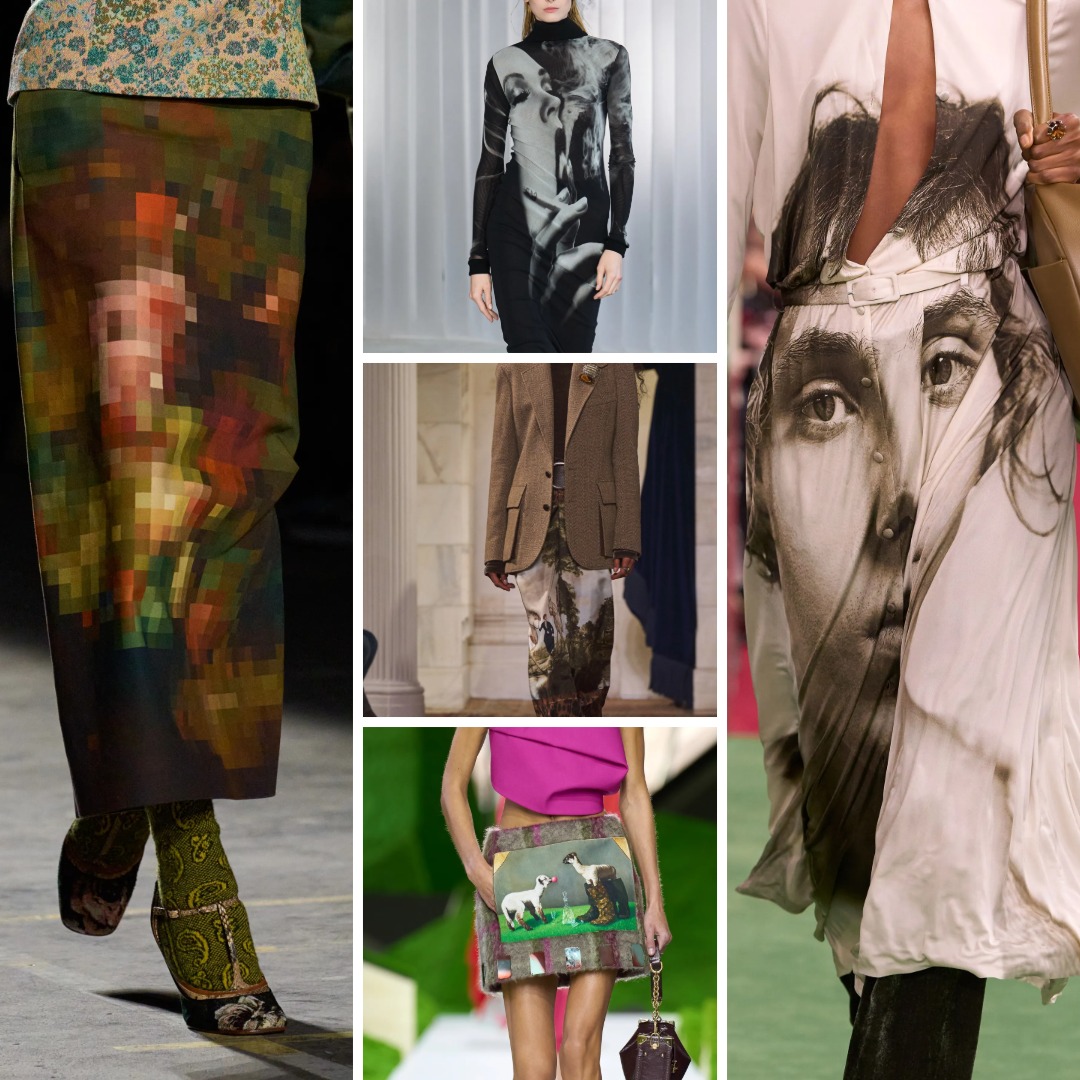
Across Fall/Winter 2026, designers including Versace, Balenciaga, Louis Vuitton, Acne Studios and others use recognisable photographs, artworks and large figurative images across garments. Who What Wear treats this as a distinct seasonal trend.
The important change is scale.
Spring/Summer 2026 showed many clear individual motifs: fruit, animals, birds, stars and flowers. They were recognisable objects placed onto garments rather than necessarily becoming a repeating pattern.
Fall/Winter 2026 pushes this further. The motif becomes a picture. Instead of treating the garment as a background for individual decorative elements, the whole surface can carry one readable image.
Obviously, this does not mean that photographic printing suddenly becomes embroidery. But the same approach to image-making can be translated into thread painting, appliqué, beadwork or mixed textile techniques.
For anyone developing an embellishment design, the useful question is therefore not only what motif should I use? It can also be how much of the garment can become the image?
What Fall/Winter 2026 Actually Tells Us About Embellishment
AW26 does not introduce new techniques. Beads, sequins, fringe, pearls, floral embroidery and appliqué are all familiar.
What has changed is where they appear and how much space they are allowed to take. Embellishment is moving beyond eveningwear into denim, bags, shoes, jackets and other everyday pieces, often becoming the main visual focus of an otherwise simple look.
For me, that is the clearest shift of the season: embellishment is not being treated as an extra detail. It is becoming part of the garment’s identity.
See also:
For comparison, you can also look back at my Fall/Winter 2025 embellishment trend review, where I examined the main decorative directions from the previous season.
I’ve also collected all the runway images featured in this article on a dedicated Pinterest board, so you can see the Fall/Winter 2026 embellishment references together in one place.
View the Fall/Winter 2026 Embellishment Trends board on Pinterest →
Written By
Ksenia Semirova
MA Textiles
An experienced hand embroidery and textile artist based in Hove, UK. Professionally practicing since 2021, mastering various techniques.
Also a fine artist and visual researcher, exhibiting her works across the UK and internationally.
Join my mailing list
Get the latest and greatest updates to your inbox!