Napoleon Jackets Are Back. But the Embellishment Is More Interesting
New to Luneville embroidery?
Start with the chain stitch—my free visual guide shows you exactly how
Military jackets have been appearing everywhere again. At first, it was easy to read them as another return from the 2000s: fitted jackets, rows of buttons, decorative braid, a bit of Kate Moss at Glastonbury. But by the time the Spring/Summer 2026 collections arrived, the reference had become much harder to ignore.
McQueen brought back officer jackets and swallowtail coats covered with frogging and fringed epaulettes. Ann Demeulemeester showed faded regiment coats. Dior played with historical military dress. Then Khaite took the familiar cord-and-button decoration away from the jacket altogether and spread it across sheer silk organza.
That last part is what interests me most.
The Napoleon jacket is clearly having another fashion moment. But for anyone interested in embellishment, the jacket itself is only half of the story. The other half is what designers are doing with its very recognisable decorative language — cords, braid, frogs, soutache, buttons and repeated horizontal lines — once they stop treating it as a historical formula.
First, was it really Napoleon’s jacket?
Not exactly.
“Napoleon jacket” is a convenient contemporary fashion term. What we are seeing today borrows from several forms of European military dress of the late 18th and early 19th centuries, and particularly from the uniforms of the Hussars, the light cavalry whose origins were associated with Hungary.
Their uniforms were hard to miss. Tight jackets were crossed with rows of braid and cord, often finished with ornamental loops and buttons. Gold and silver decoration could cover much of the chest.
The Napoleonic Wars made this type of military dress highly visible, and fashion quickly borrowed from it. FIT’s Fashion History Timeline notes that women’s outerwear of the 1810s was full of military references: braid, tassels, cords and frogging appeared on pelisses, redingotes and short spencer jackets. Hussar uniforms were a particularly strong influence.
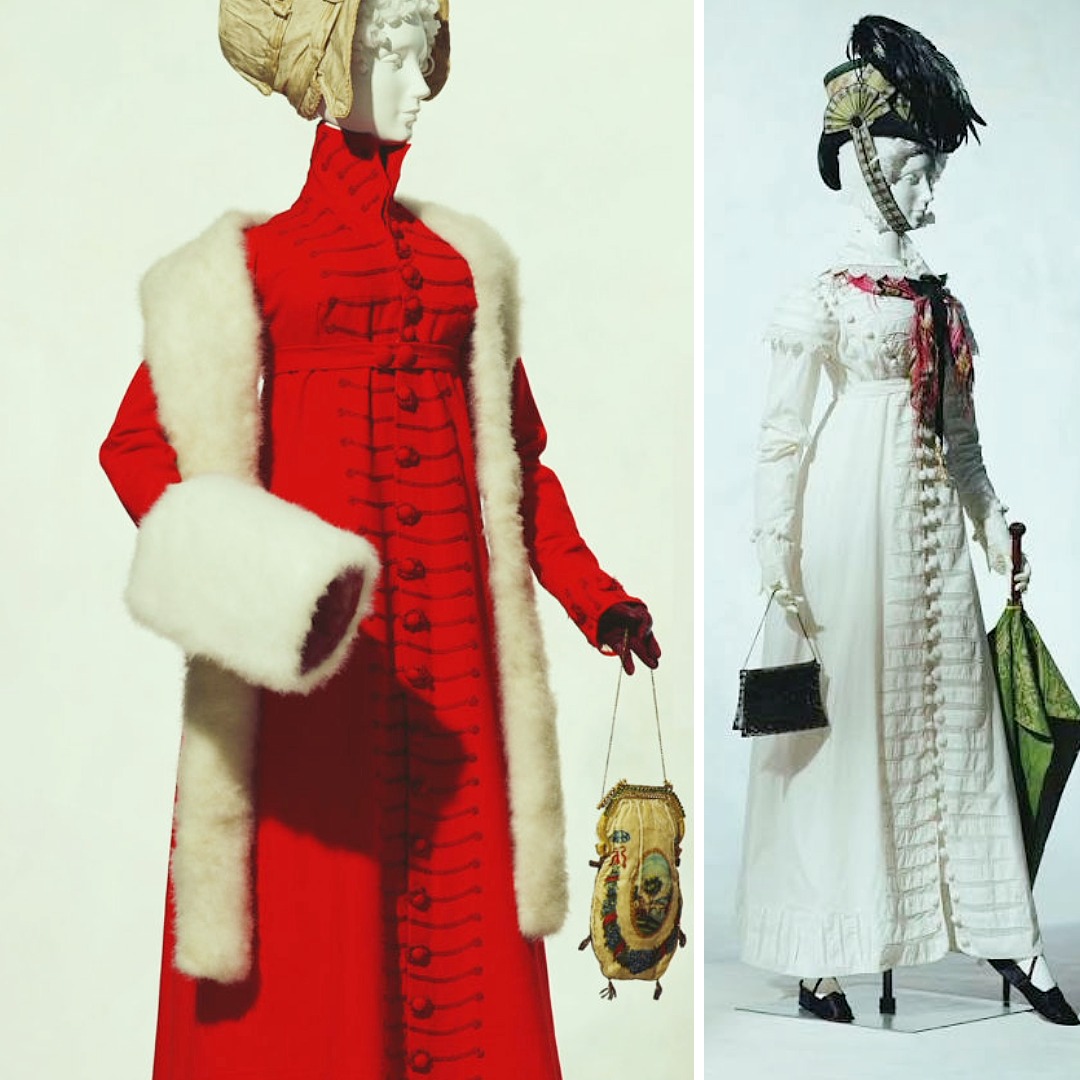
There is a wonderful surviving example from around 1815 in the Kyoto Costume Institute: a white cotton Redingote à la Hussarde. Instead of looking remotely like a dark military coat, it is a delicate white women’s garment, but the entire front is decorated with Hussar-style Brandenburg piping and pompoms. KCI explains that this type of closure originated with Hussar cavalry and was subsequently adopted for women’s clothing.
So, interestingly, translating military decoration into fashion is not something designers invented in 2026. It was already happening while Napoleon was alive.
And this is also where frogging comes in.
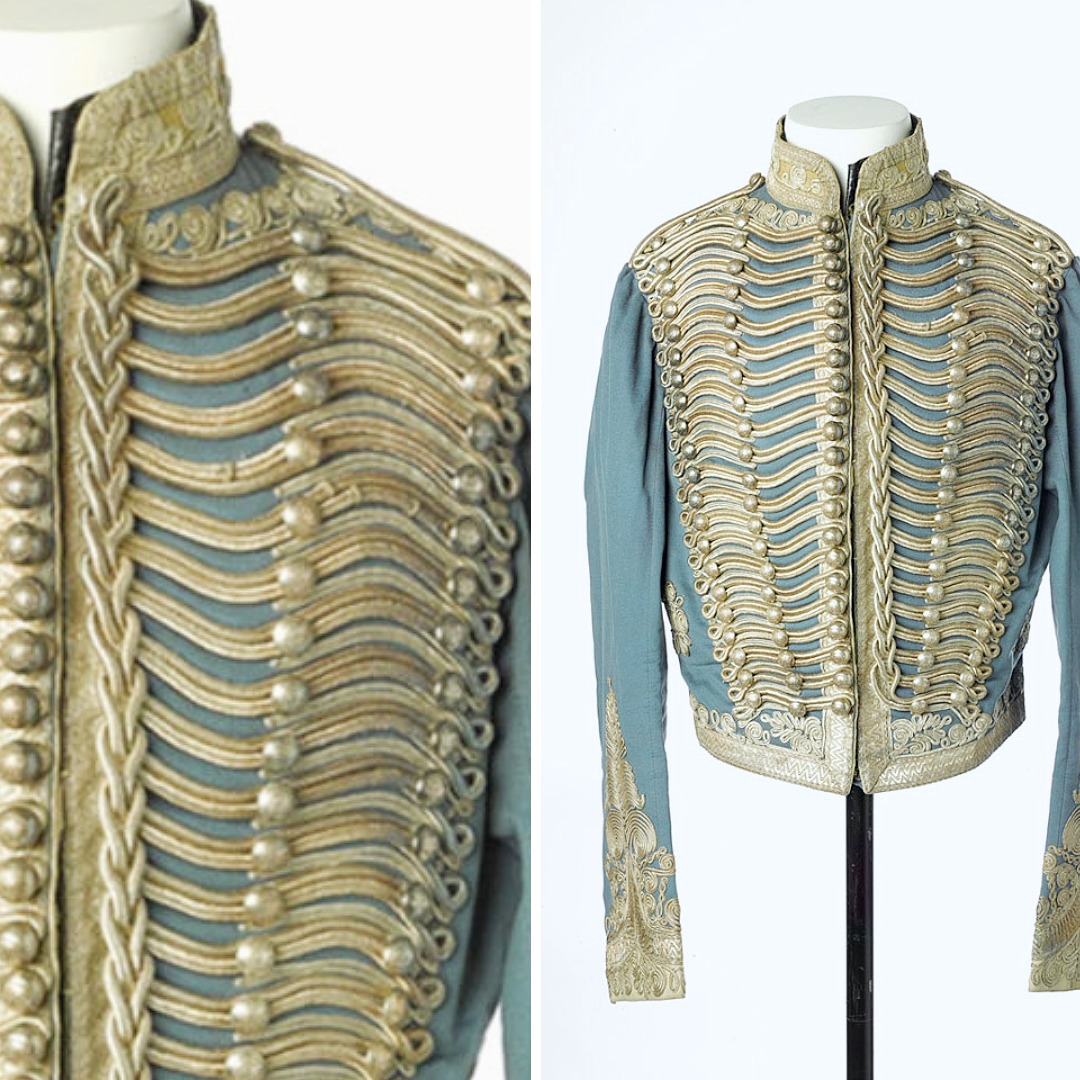
Today we tend to recognise it as those rows of looping cord across the front of a military-style jacket. FIT defines frogging simply as ornamental braid or cording which may function as a closure or may be completely decorative.
That second part is important. What looks like a complicated fastening does not necessarily need to fasten anything. The decoration had already started separating itself from function.
From uniform to fashion — and then to the stage
Military decoration never really disappeared from fashion.
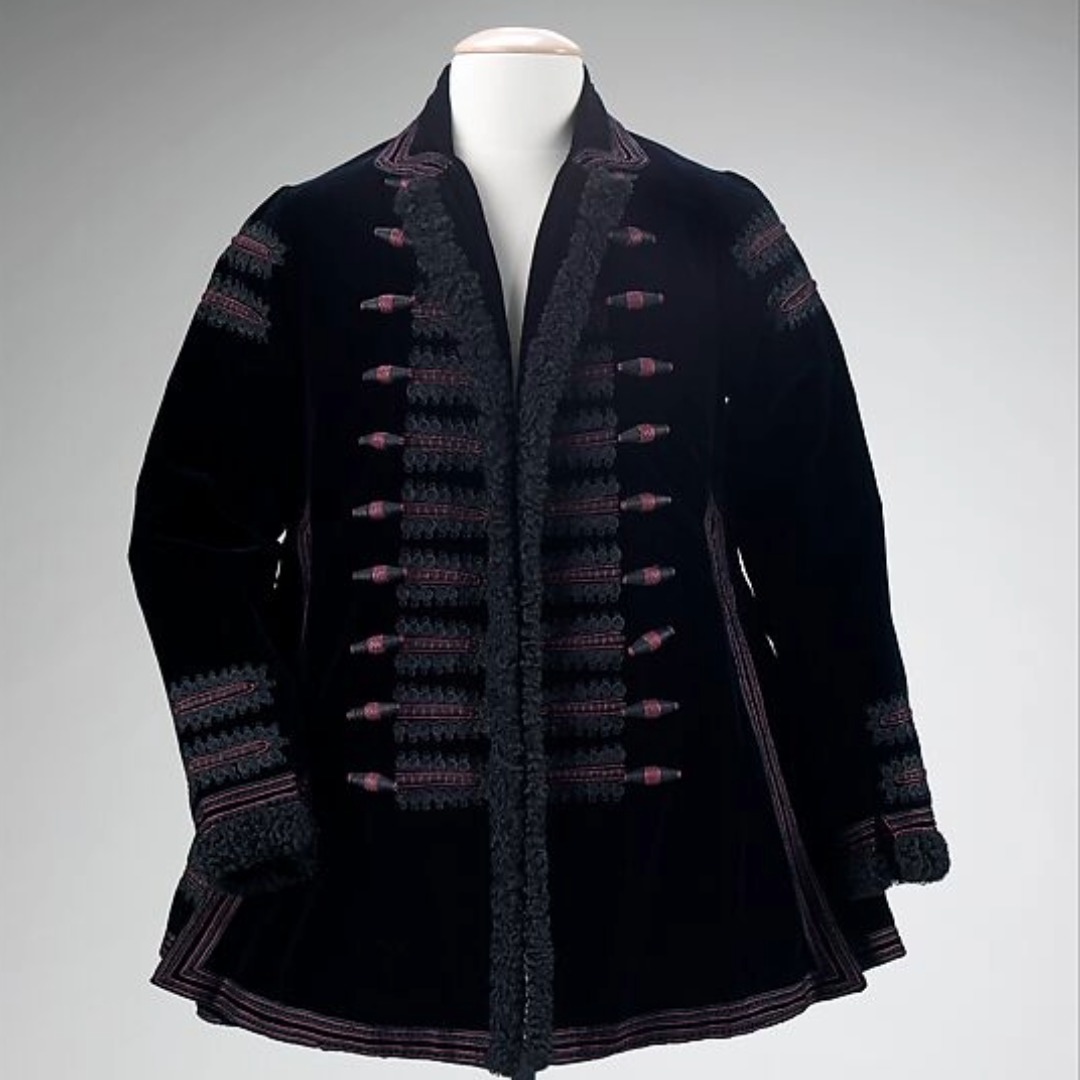
A beautiful example from much later is a Callot Soeurs jacket from around 1920 in the Metropolitan Museum of Art. Dark velvet is decorated with magenta soutache braid and toggle buttons. The Met specifically identifies the placement of the braid and buttons as references to Hussar uniforms, but also makes the point that Callot Soeurs did not simply reproduce those sources. They were reinterpreted into a contemporary fashionable garment.
That distinction is worth remembering when looking at what is happening now.
But there is another chapter in the story which probably matters even more to the present revival: music.
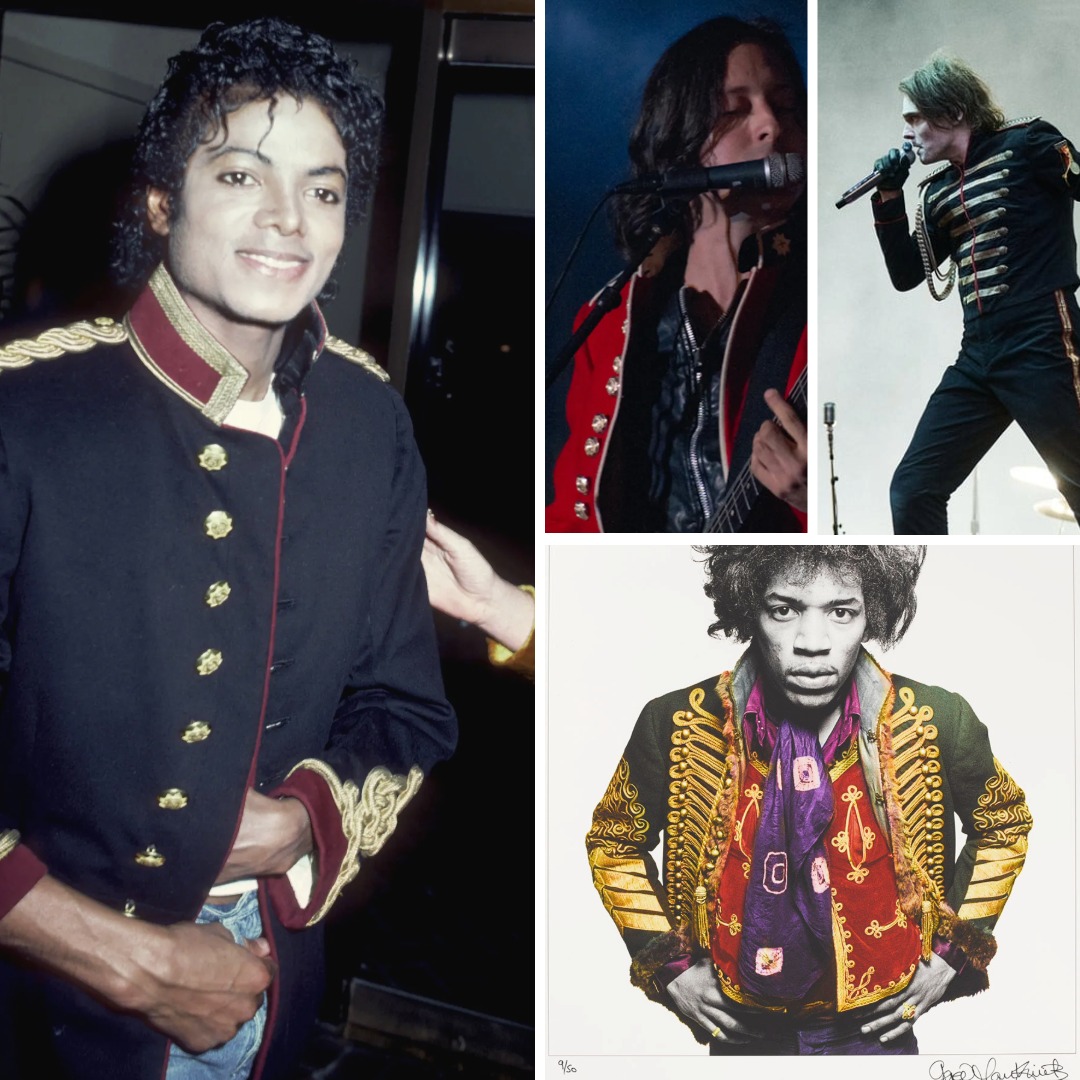
The decorated military jacket has an unusually long relationship with performers. The Beatles, Jimi Hendrix, Mick Jagger, Michael Jackson, My Chemical Romance and others all used variations of military dress as stage clothing. British Vogue traces exactly this lineage when discussing the current comeback.
Michael Jackson is perhaps the clearest example of how far military decoration could be pushed.
His military jackets became part of his visual identity, covered not simply in braid but in soutache, bullion embroidery, rhinestones and other decoration. His long-term costume designer Michael Bush described Jackson’s fascination with European military and royal dress; British Vogue notes that these heavily embellished jackets became one of his signatures.
The military jacket had stopped being a uniform long before this point. In Jackson’s wardrobe it became spectacle.
And then came the 2000s.
Kate Moss, Balmain and the first Napoleon-jacket revival many of us remember
For a lot of people, the immediate reference behind today’s Napoleon jacket is probably not the 1810s at all.
It is Kate Moss in 2005.
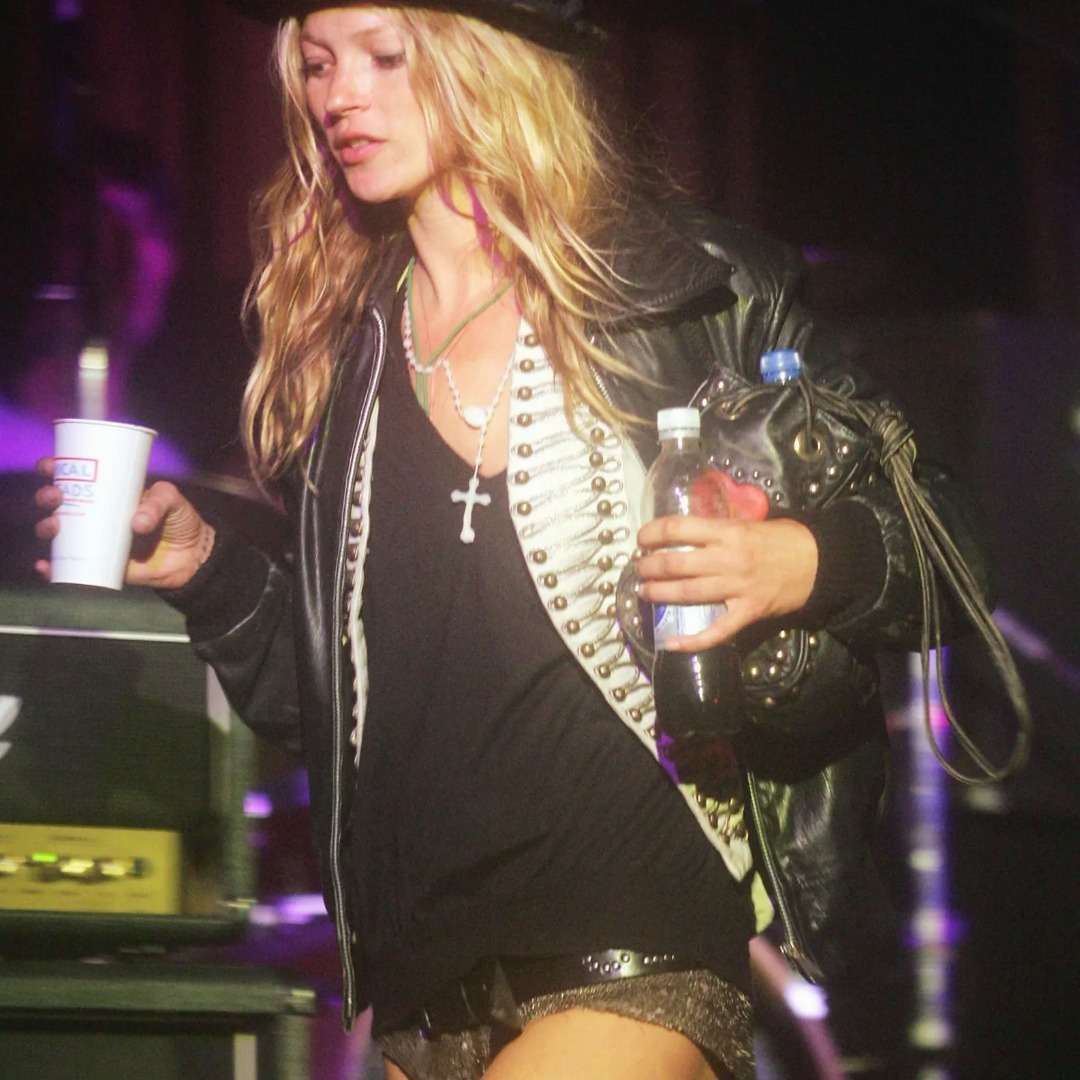
One of her best-known Glastonbury looks paired a cream military jacket with tiny denim shorts, boots and Pete Doherty’s trilby. That combination became part of the visual language of mid-2000s British fashion: military jackets with skinny jeans or shorts, boots, deliberately undone styling and a strong connection to music. British Vogue has repeatedly returned to that image while tracking the jacket’s comeback.
What makes that history especially relevant now is that it isn't simply an editor making a nostalgic comparison.
Seán McGirr has said that the Napoleon jackets in his McQueen Spring/Summer 2026 collection came partly from his own teenage memories of Pete Doherty and Kate Moss wearing them. Friends then pointed out another reference buried in the collection: Gerard Way of My Chemical Romance. “These things stay with you,” McGirr told Harper’s Bazaar.
That is perhaps one of the clearest explanations for why the jacket has returned now. The people who absorbed these images twenty years ago are now creating the collections.
And fashion had already taken the jacket to an extreme once before. Christophe Decarnin’s Balmain Spring 2009 collection included what Vogue called “drummer-boy Michael Jackson jackets”, with their military frogging picked out in crystal.
That detail is worth noting. Even in 2009, the cord did not necessarily have to remain cord.
What is different in 2026?
This time there isn't one Napoleon jacket.
There is a recognisable starting point, but designers are pulling it in very different directions.
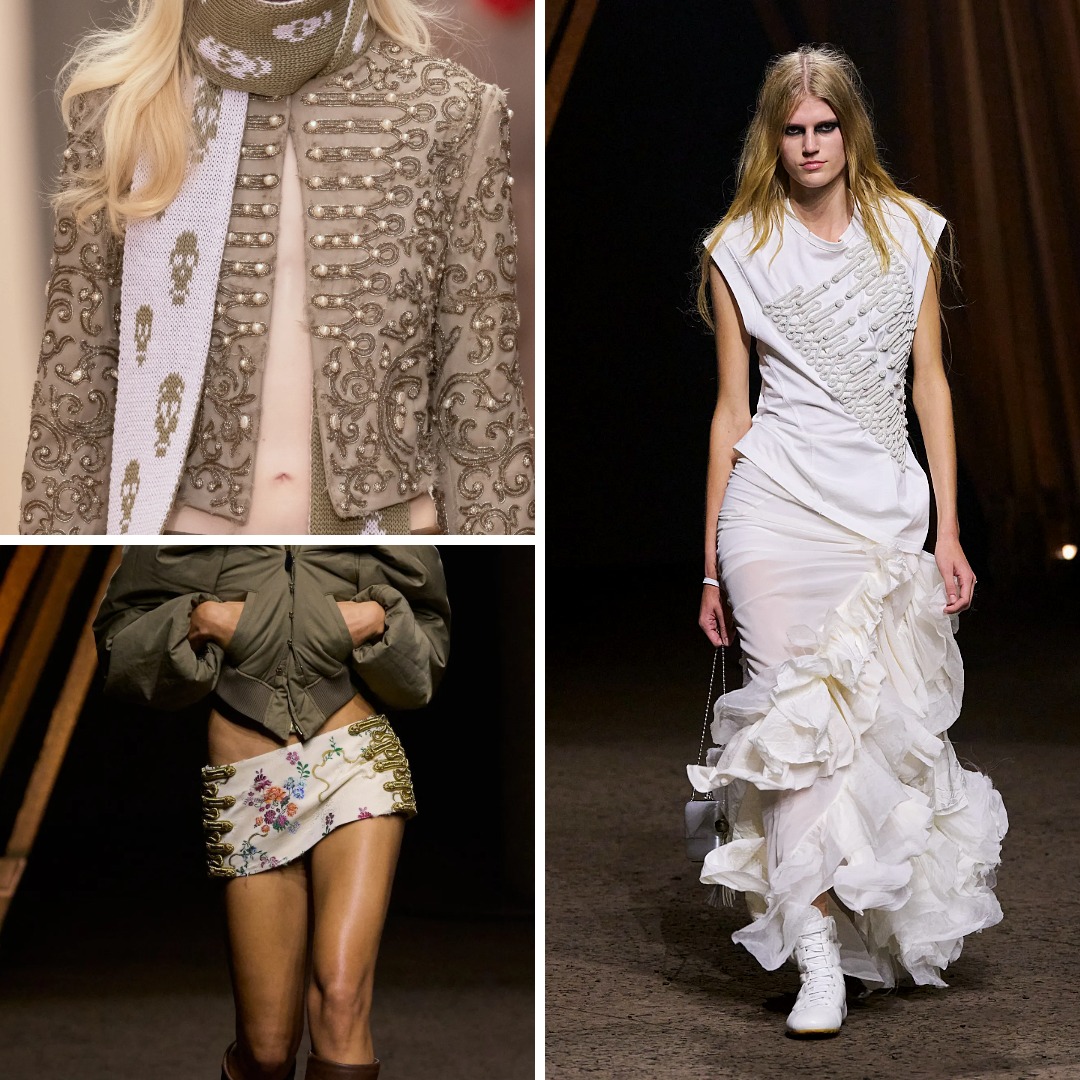
At McQueen Spring 2026, Seán McGirr went relatively close to the historical source. Vogue describes officer jackets and swallowtail coats with 19th-century frogging and fringed epaulettes. But they are paired with very low trousers, bare skin and deliberately less formal pieces. The historical detail is intact; the context is completely different.
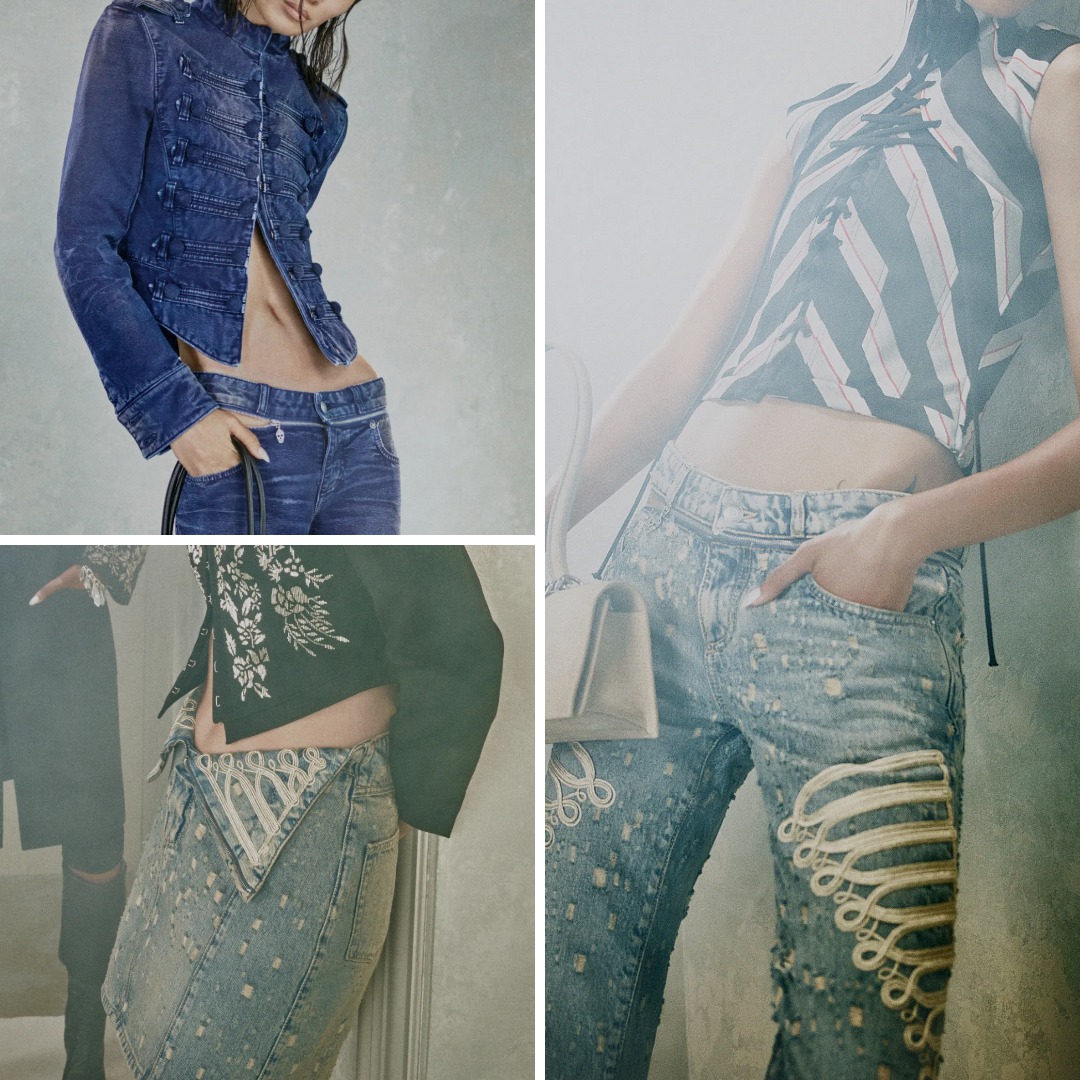
Then something interesting happens in McQueen Pre-Fall 2026: the frogging moves onto bleached jeans.
The officer jacket is no longer required.
That is where I think the current trend becomes much more useful from an embellishment point of view. Once a decorative element starts migrating between garments and materials, it is no longer just about reproducing a particular historical silhouette.
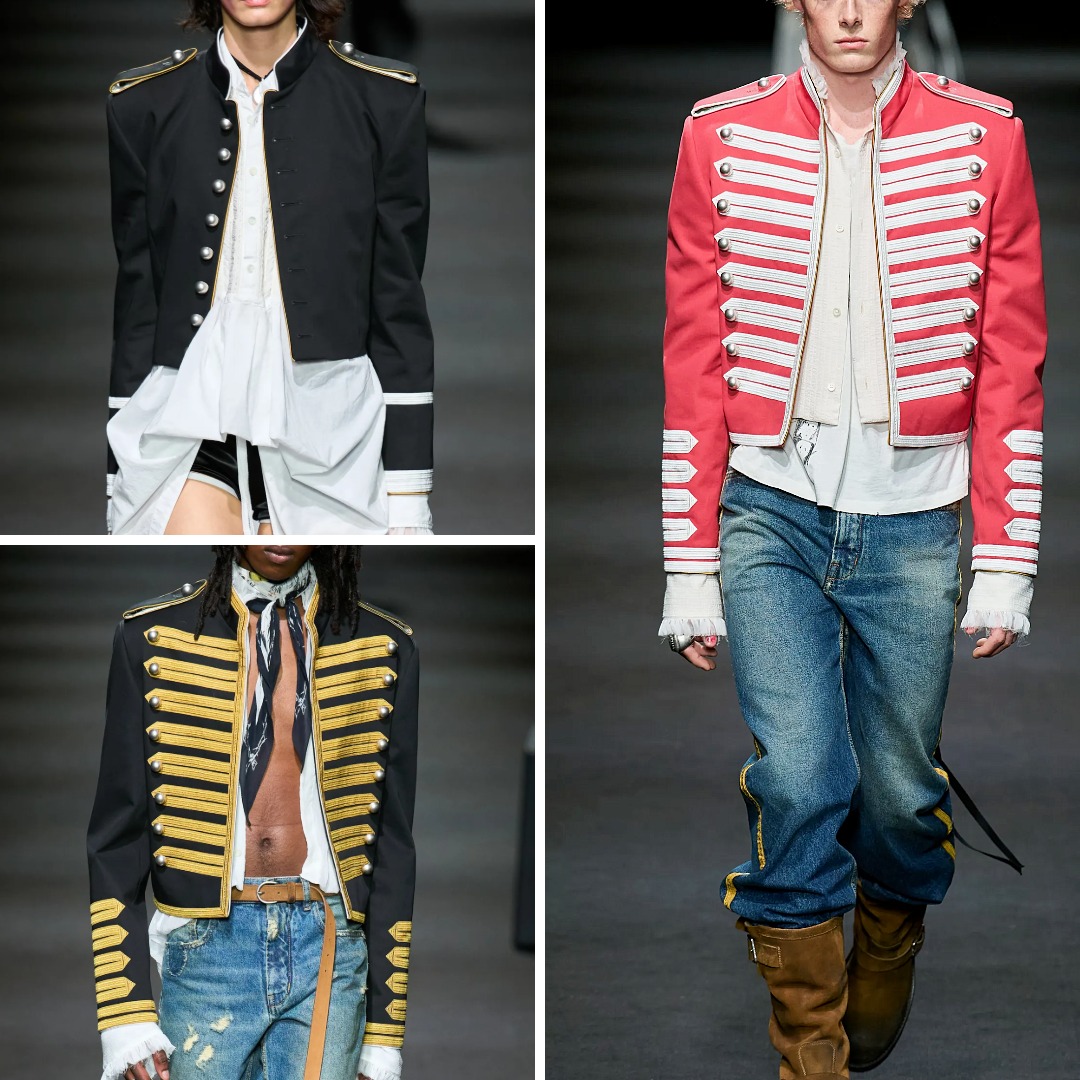
At Ann Demeulemeester Spring 2026, Stefano Gallici approached the same history through rock and romantic dress. The collection included faded-looking red regiment coats, which Vogue placed in a world of neo-Victoriana and Jimi Hendrix-like stage dressing rather than historical reconstruction.
And the reference continues into Pre-Fall 2026, where Vogue explicitly notes Napoleonic jackets in pinstripe wool.
Then there is Khaite Fall 2026.
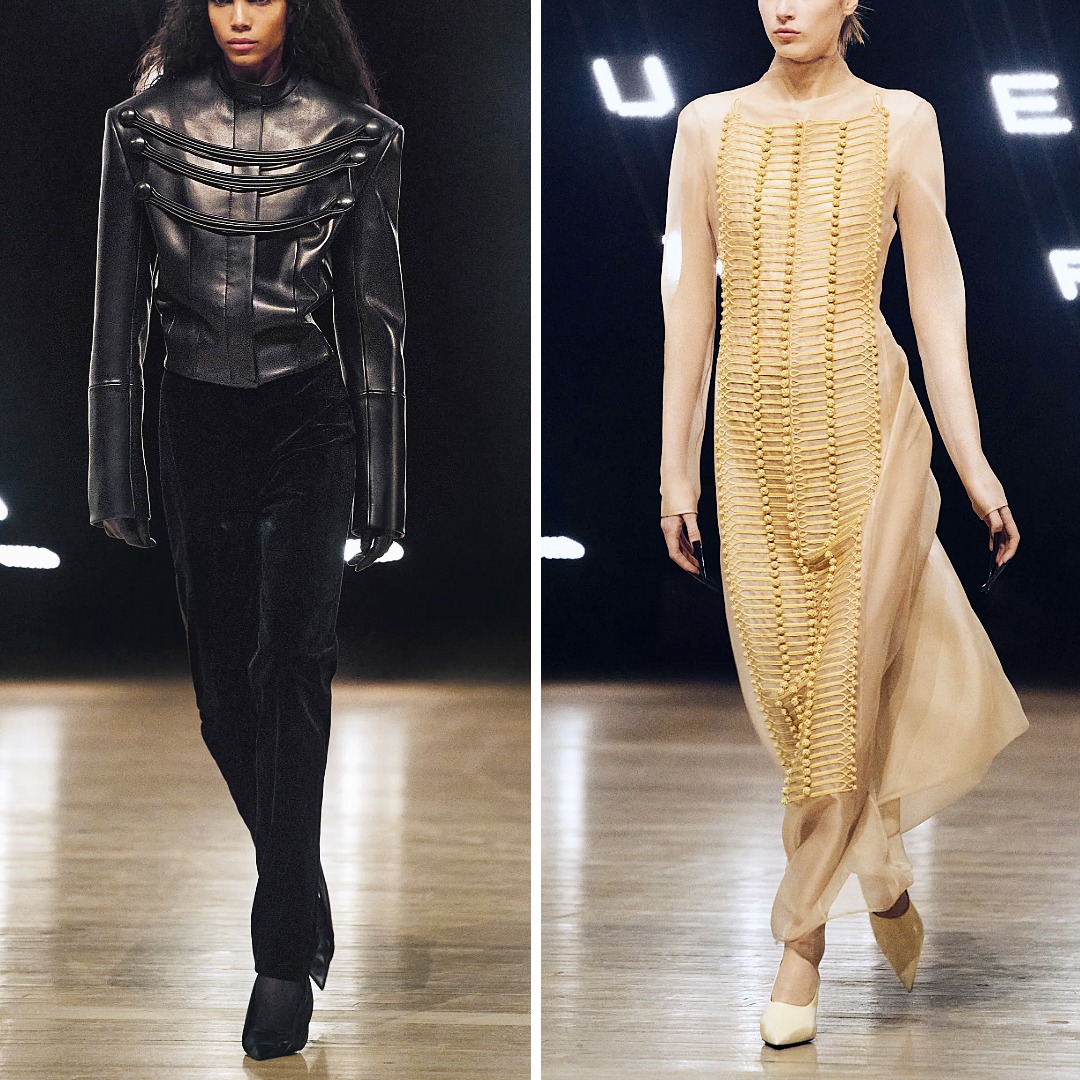
The black leather York jacket uses tonal decorative cords across the front. From a distance it is immediately recognisable as military dressing, even though the expected gold braid has disappeared. Vogue describes Catherine Holstein’s officer jackets as having decorative braids swagged across the chest.
Black on black changes quite a lot. There is no obvious flash of ceremonial gold. The reference survives simply through the placement, rhythm and shape of the cords.
But Khaite goes considerably further with the Toldo dress.
The dress is made from sheer silk organza and hand embroidered with military-inspired gold cording and soutache buttons. Khaite states that each dress represents at least 100 hours of artisan craftsmanship.
This is no longer a military jacket with decoration attached to it.
The decoration has effectively become the garment’s surface.
Rows of cording travel down a transparent column of organza, repeating the visual rhythm associated with military frogging but without the heavy wool coat, epaulettes or conventional uniform construction around it.
For me, this is one of the most interesting interpretations of the trend.
Those cords and rounded buttons are only the beginning
There is a danger with any historical trend that its most obvious visual elements become a recipe.
Take dark fabric. Add gold soutache. Make symmetrical loops. Add those distinctive rounded or wrapped buttons. Finished: Napoleon jacket.
But current collections are showing something more useful. The reference can survive when almost everything else changes.
It can become tonal, as with black-on-black decoration. It can move onto denim. It can cover organza. It can be replaced by beads, crystals or another form of embroidery. It can even stop being applied decoration altogether.
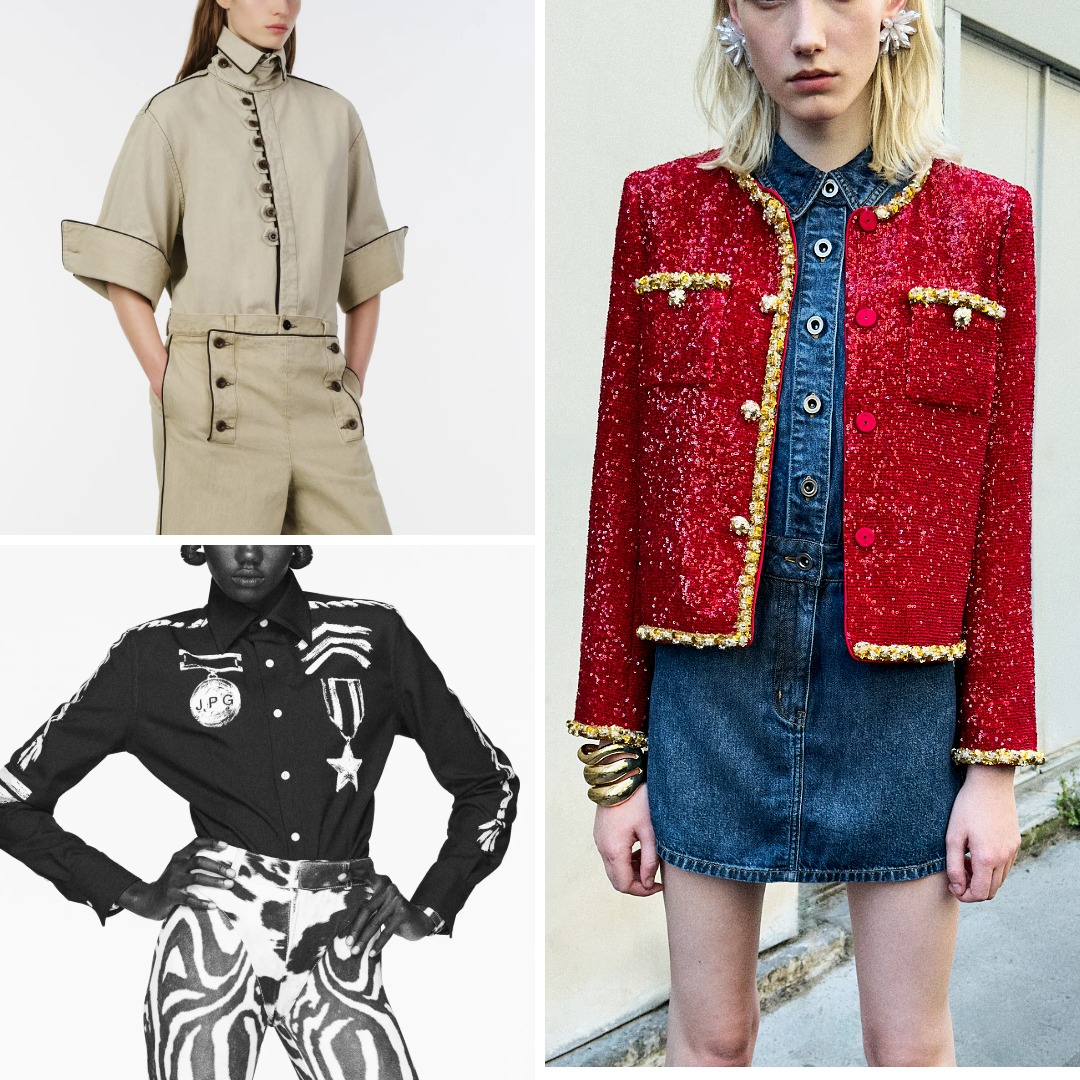
Sacai Resort 2027, for example, uses military-inspired button-and-loop plackets as one construction detail among otherwise contemporary clothes.
At Jean Paul Gaultier Resort 2027, Duran Lantink takes another route: medals and military regalia are printed onto denim jackets and peacoats. Something that historically would have been dimensional, metallic and attached to the garment becomes an image of itself.
And Self-Portrait Resort 2027 offers a red-and-gold marching jacket covered in thousands of paillettes. It still reads immediately as ceremonial military dress, but the surface belongs much more to contemporary embellished fashion than to traditional braid work.
This is probably the part I find most useful.
Instead of thinking of frogging as a technique that has to be reproduced literally, it makes more sense to look at the design system behind it.
There is repetition. Symmetry. Horizontal movement. A central opening. Lines terminating in buttons or other focal points. The contrast between a flat garment and raised decoration. The possibility of extending, multiplying or interrupting those lines.
Once you separate those principles from soutache cord, there are a lot more possibilities.
Beads could form the lines. Pearls could replace wrapped buttons. Sequins could follow the rhythm without copying the original shape. Cords could become huge and sculptural or almost disappear into the fabric. A motif could be fragmented so that only part of the original symmetry remains.
The connection can still be understood without making something that looks as though it came from a costume department.
And then there is Jimin
The recent celebrity appearances are useful because they show how quickly this has moved beyond runway styling.
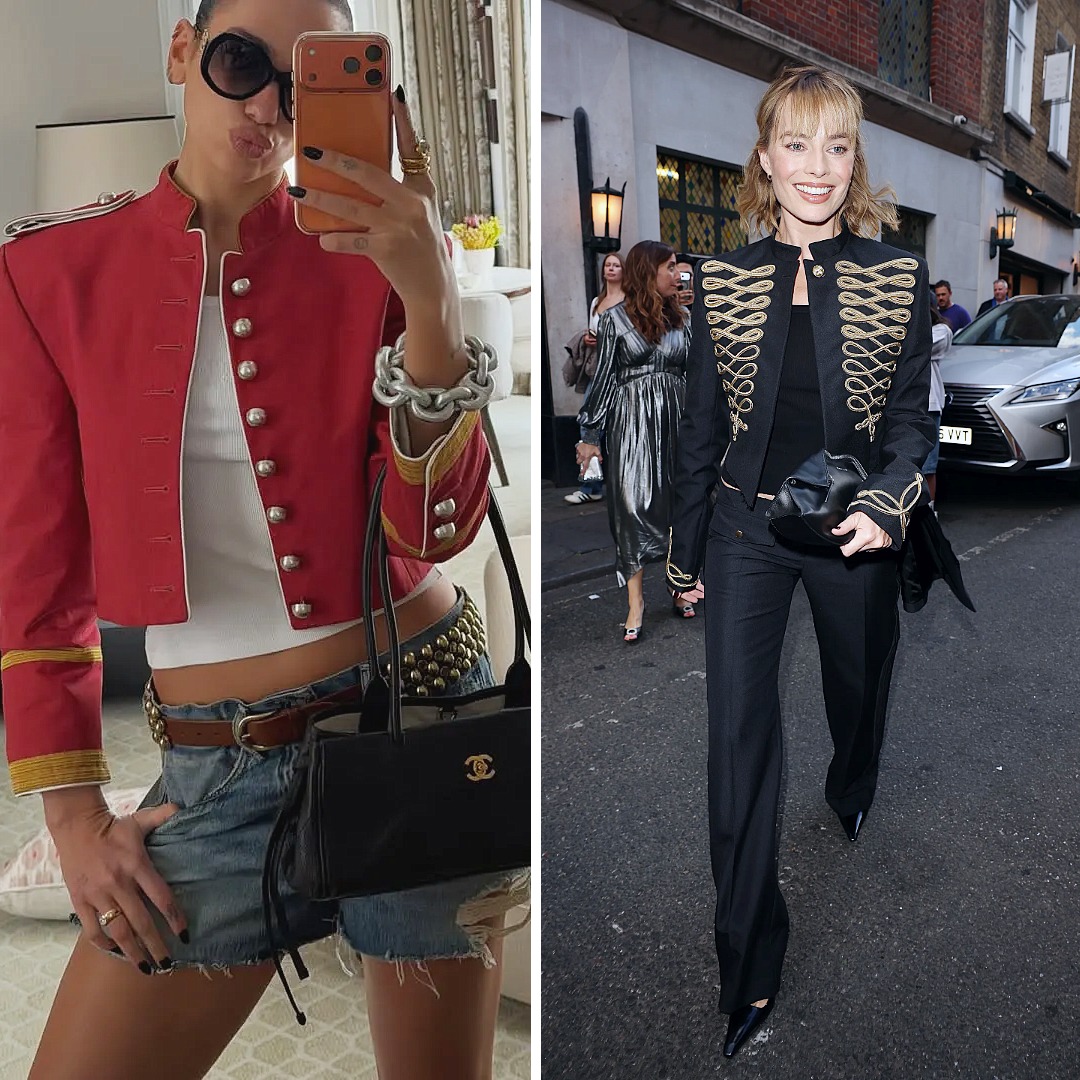
Dua Lipa wore Ann Demeulemeester’s red Spring 2026 military jacket with a white tank and denim shorts in January — a combination Vogue immediately compared with Kate Moss’s 2000s styling.
Margot Robbie later wore McQueen’s cropped black jacket with gold frogging in London. Jenna Ortega has appeared in Dior’s Napoleon-style vest.
But the example I find more interesting is Jimin of BTS.
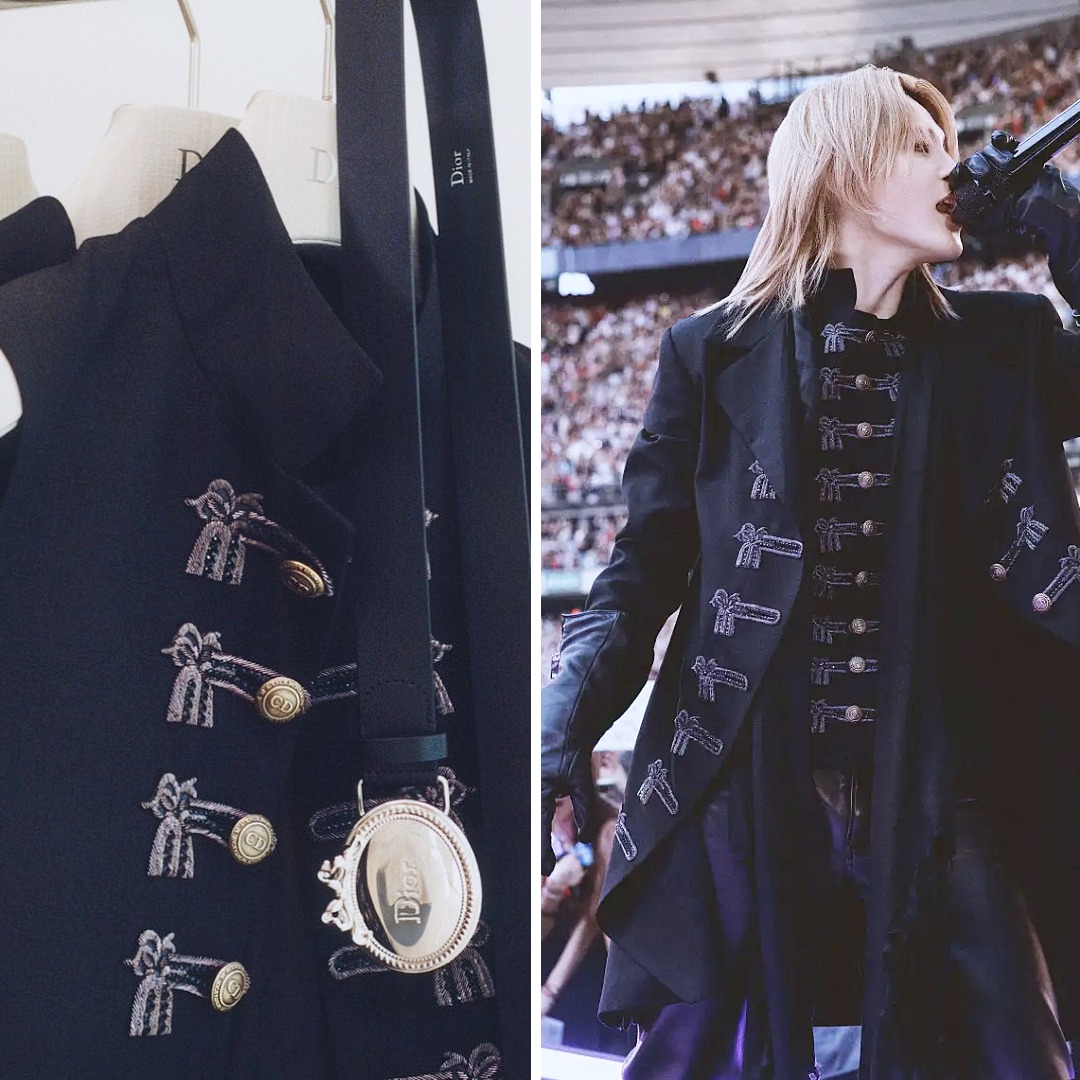
For the BTS concerts at Stade de France in July 2026, Dior dressed him in a black wool jacket and matching waistcoat with black Brandebourg embroidery, worn with black leather trousers. This is not an interpretation made by fashion press: Dior’s own release identifies the decoration as Brandebourg embroidery.
Again, no gold. Almost no colour contrast at all. Yet the historical military reference is completely readable.
And there is something appropriate about seeing this jacket return to the stage. From Jimi Hendrix and Michael Jackson to Gerard Way and now K-pop, elaborate military dress has repeatedly found a second home in performance.
It makes sense. A repeated row of cords, buttons, braid or embroidery can be read from a distance. It frames the torso. It catches light. It creates a strong graphic shape before anyone has examined the technique closely.
So why is it back now?
There probably isn't one answer.
The easiest explanation is the return of 2000s fashion, and there is obviously some truth in it. Kate Moss is being referenced again; indie and rock styling has returned; and McGirr openly connects his own Napoleon jackets with images he absorbed as a teenager.
But that does not explain Khaite’s organza dress, Dior’s historical experiments or the wider amount of ornament appearing on the runways.
WGSN’s Autumn/Winter 2026/27 forecast describes romance moving towards a more opulent, ornamented expression, with historical references and heritage craft techniques becoming more important on the catwalks.
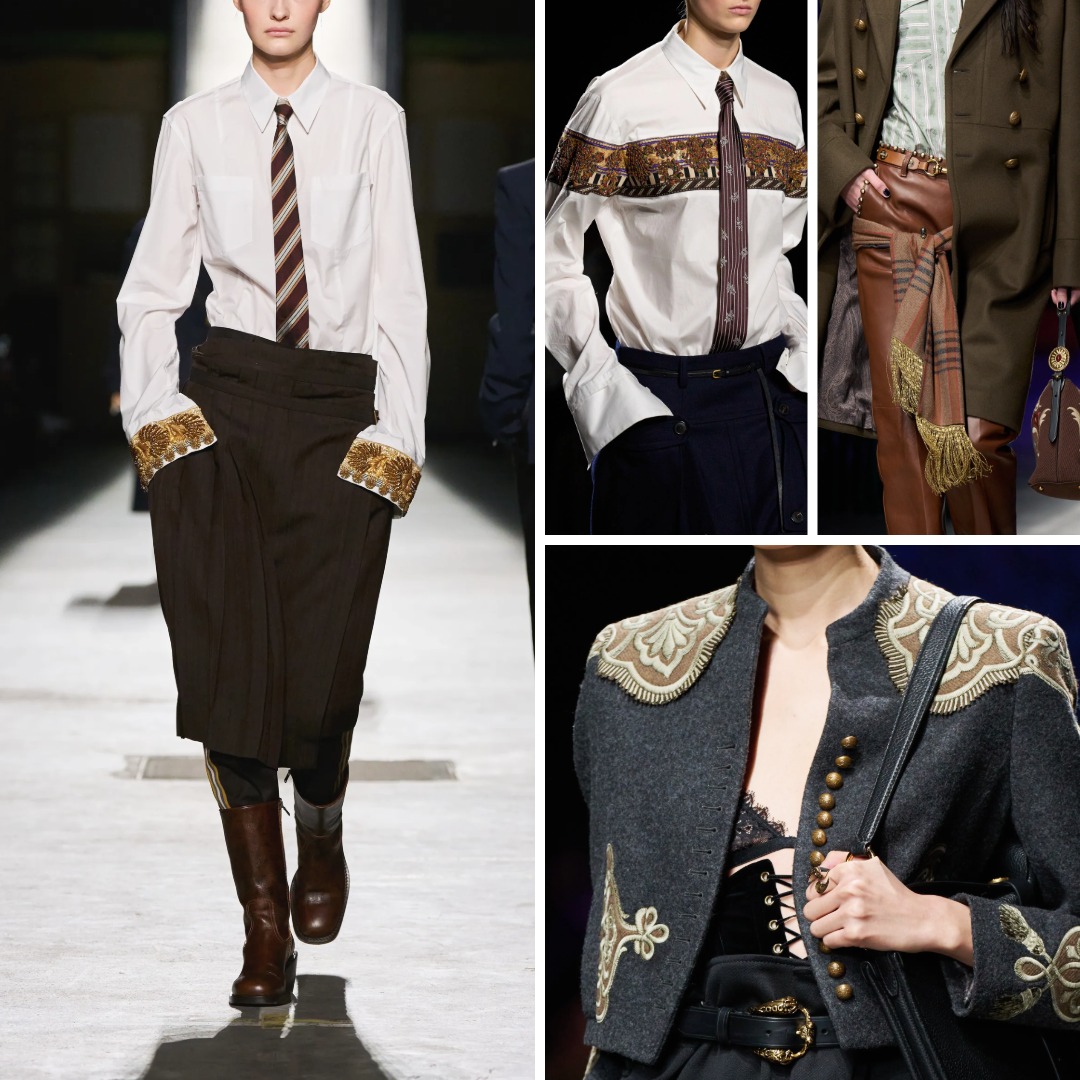
At the same time, the fitted and cropped jacket is returning after years in which oversized tailoring dominated much of fashion. British Vogue has already noted the shift towards shorter jackets that sit closer to the body.
And there is another factor: fashion looks ready for visible decoration again.
Not necessarily decoration in the old sense of “more crystals, more sequins”. It is the return of garments where the detail itself carries a large part of the design — braid, embroidery, buttons, trim, texture, historical construction references.
The Napoleon jacket happens to fit comfortably into several current conversations at once: 2000s nostalgia, rock dressing, historical references, fitted tailoring and more visible ornament.
That is a much stronger position than being attached to one isolated microtrend.
Will Napoleon jackets still be fashionable next year?
For once, we already have part of the answer.
The revival was clearly established by Spring/Summer 2026, but it didn't stop there.
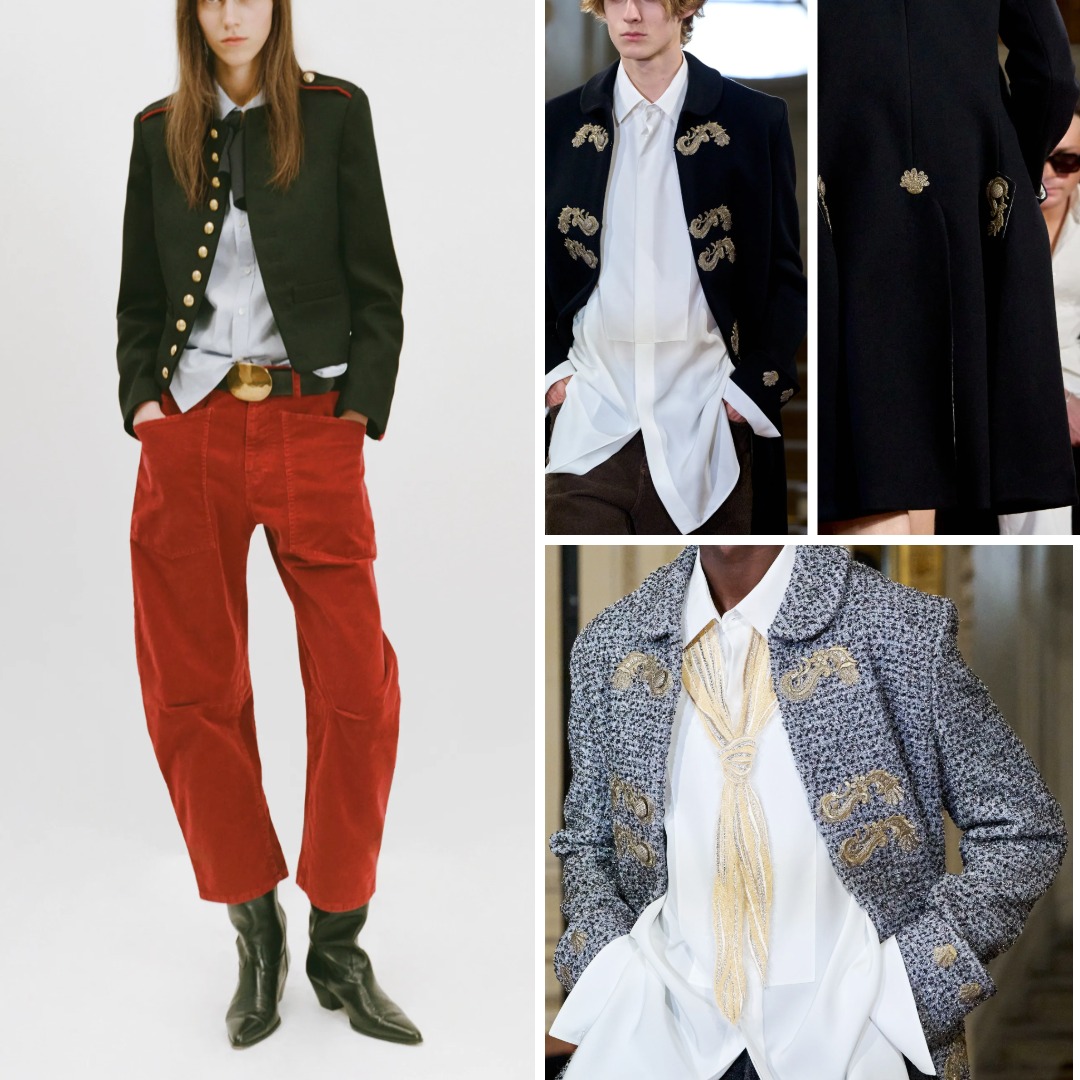
Nili Lotan doubled down on embellished military jackets for Pre-Fall 2026, and for Resort 2027 Vogue describes uniform-inspired military dressing as the collection’s “main event”, including tailcoats and brass decoration.
Jonathan Anderson is also continuing the idea at Dior. In Dior Men Spring/Summer 2027, Napoleon jackets reappear in blue and black, some with silver embellishment.
So as of September 2026, there is enough evidence to say this is not simply a one-season Spring 2026 trend.
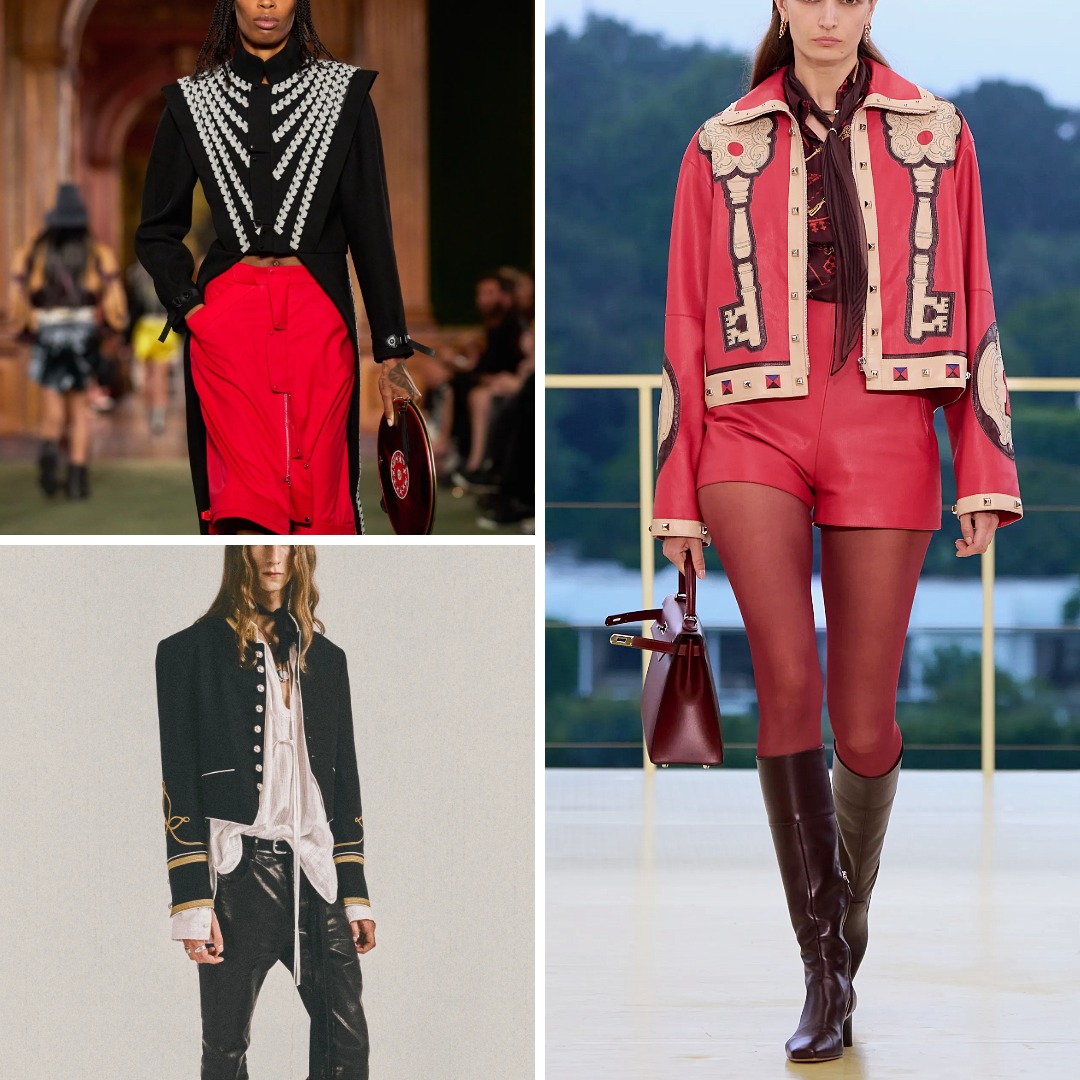
WGSN’s early Spring/Summer 2027 womenswear forecast is also interesting. It predicts both a rock-influenced “New Glam” direction and continuing interest in vintage and romantic references. Neither forecast specifically says “Napoleon jacket”, and I wouldn't pretend that it does. But both give this type of clothing somewhere to go after the initial revival.
I would be much more cautious about predicting the literal Napoleon jacket far into 2028. There isn't reliable evidence for that yet.
But I am less convinced that its embellishment language will disappear at the same time.
Once designers start taking a recognisable detail away from its original garment — putting military frogging on jeans, turning ceremonial decoration tonal black, covering organza with cording, replacing braid with paillettes or printing medals onto denim — the idea has already begun to evolve into something else.
And perhaps that is the more interesting trend to follow.
Not whether everyone will still be buying a Napoleon jacket two years from now, but what will happen to those cords, loops, buttons and repeated lines once designers no longer need the jacket at all.
See also:
Military references are only one part of the season — you can see the wider picture in my Fall/Winter 2026 Embellishment Trends report.
Written By
Ksenia Semirova
MA Textiles
An experienced hand embroidery and textile artist based in Hove, UK. Professionally practicing since 2021, mastering various techniques.
Also a fine artist and visual researcher, exhibiting her works across the UK and internationally.
Join my mailing list
Get the latest and greatest updates to your inbox!