The Schiaparelli Rose Coat: More Than a Beautiful Back View
New to Luneville embroidery?
Start with the chain stitch—my free visual guide shows you exactly how
The V&A is currently showing Schiaparelli: Fashion Becomes Art, the UK’s first exhibition dedicated to Elsa Schiaparelli. It traces the house from the 1920s to today and includes work from the current Daniel Roseberry era as well as historic pieces by Elsa Schiaparelli. I have already visited twice, and I will definitely go again.
Schiaparelli has a special place in my heart. Not because her clothes are simply “beautiful”, but because they prove that fashion can be clever, strange, technically serious, and still wearable. Her work does not ask permission to be decorative, humorous, theatrical, or intellectually sharp. That is one of the reasons I keep coming back to it.
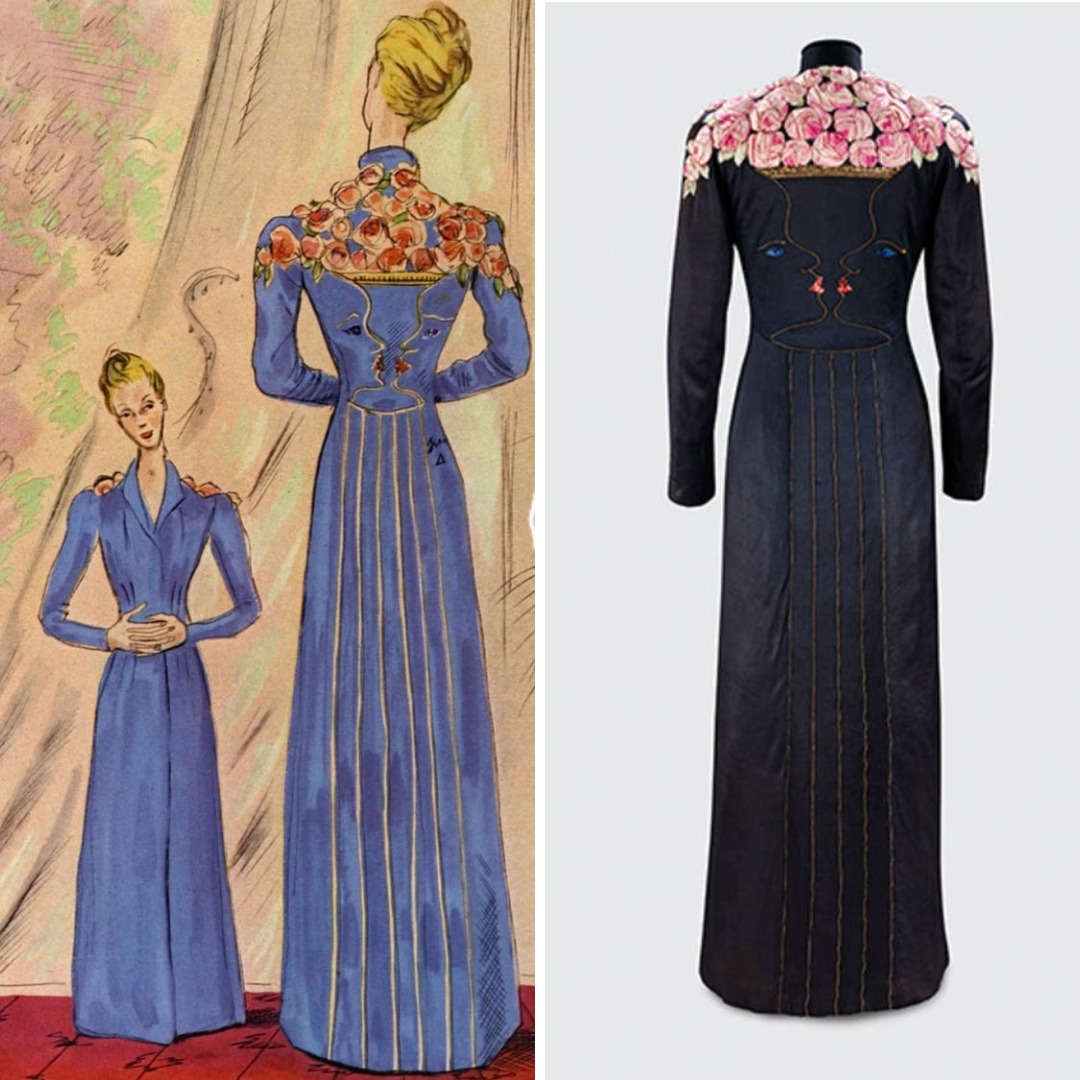
One garment in the exhibition stayed with me especially: the 1937 rose evening coat designed by Elsa Schiaparelli in collaboration with Jean Cocteau and embroidered by Lesage. I had seen it many times in photographs. Seeing it in real life was different. The famous back view is still the main attraction, but the object itself is more complex than a beautiful museum image. So I decided to look closer and do more research.
What is this garment?
The V&A identifies the garment as an ankle-length evening coat made in 1937 by Elsa Schiaparelli, Jean Cocteau and Lesage. It is described as black silk jersey, with facial profiles forming a rose-filled vase. Maison Schiaparelli places it in the Autumn 1937 Haute Couture collection and says it was inspired by a drawing Cocteau gave to Elsa Schiaparelli that year.
So, although people sometimes casually call it a jacket, the object I am discussing here is an evening coat. That matters because the length gives the back image space to work. The embroidered lines are not a small motif placed on a garment. They occupy the back like a drawing stretched over the body.
There is also a related Schiaparelli and Cocteau evening jacket from fall 1937 in The Met collection, made with Lesage. This tells us the coat was part of a wider collaboration between Schiaparelli, Cocteau and the embroidery atelier, not a single decorative accident.
The image on the back
The famous back view is not just a floral design. It is a double image.
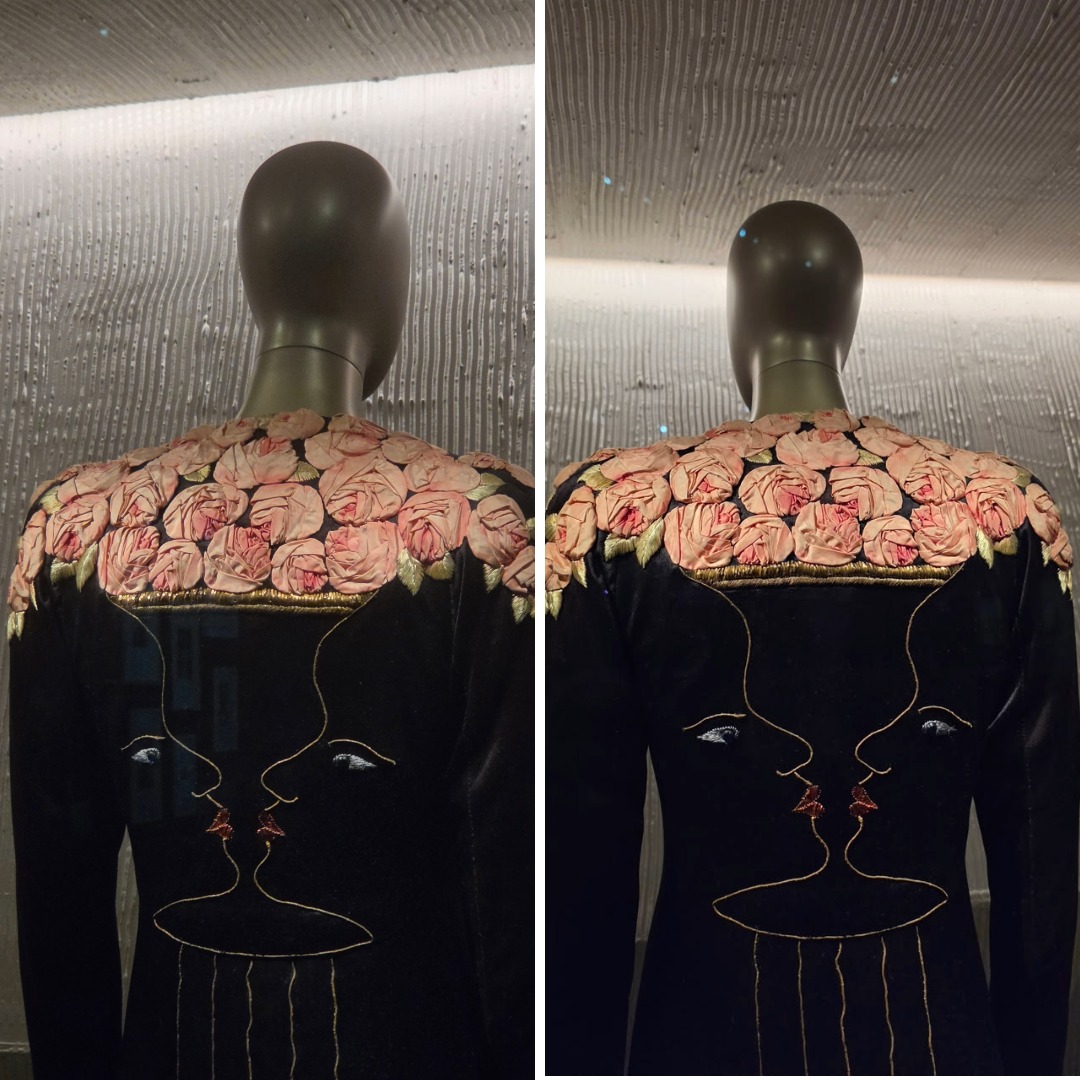
You can read it as two faces in profile, turned towards each other. You can also read the space between them as a vase filled with roses, placed on a fluted column. Maison Schiaparelli describes it as an optical illusion, and the V&A Americas Foundation connects it to Cocteau’s interest in double images and the Surrealist fascination with visual ambiguity.
That is the reason the coat still holds attention. It asks the viewer to look twice. First you see roses. Then you notice the faces. Then the vase appears. Then the whole back starts working as one image.
This is not “flower embroidery”. It is an embroidered drawing with a built-in shift of meaning.
The roses are not just decoration
The roses are the first thing most people notice, and that is probably intentional. They cover the shoulders in a dense pink mass, while the faces, vase and column are drawn with fine gold lines on the dark coat.
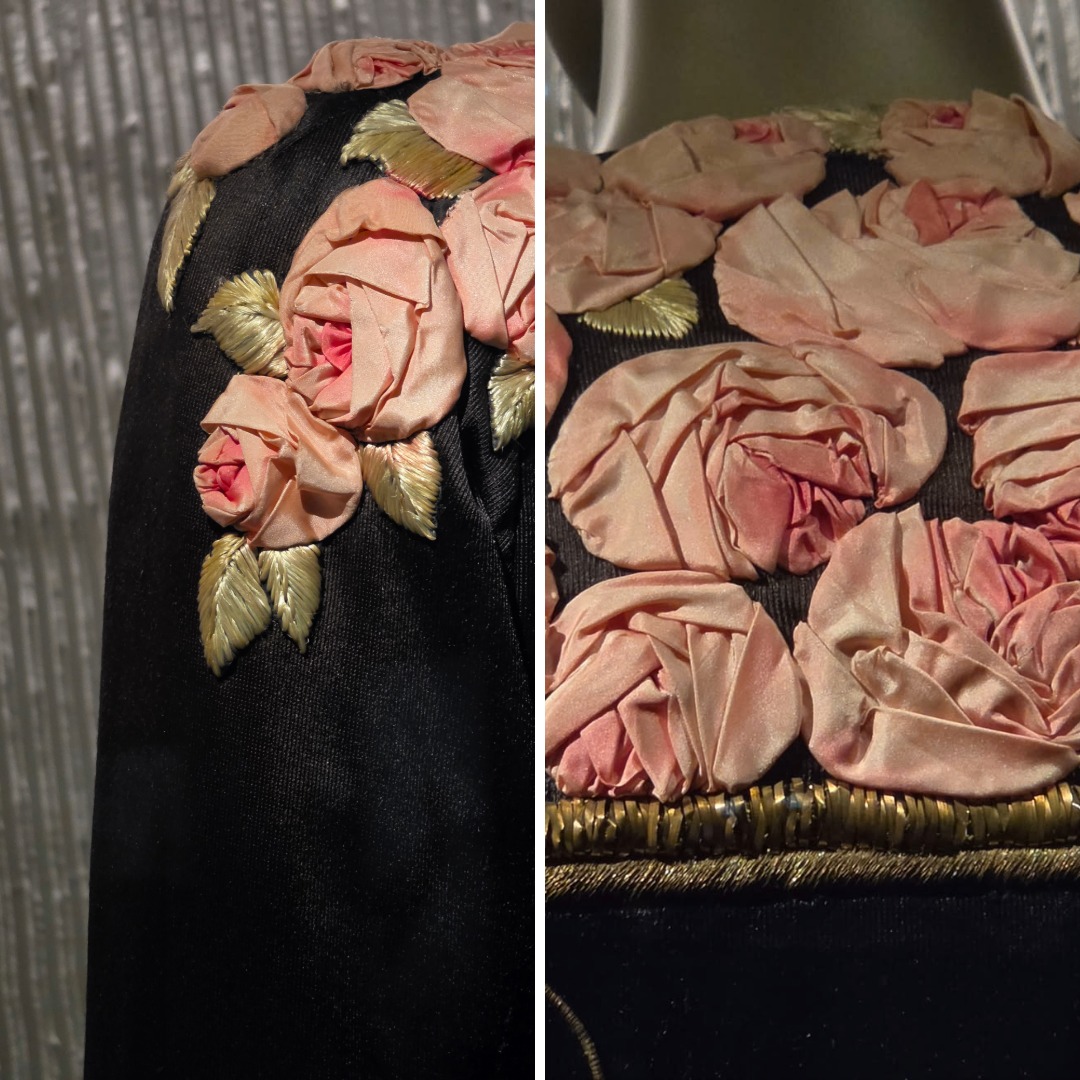
The available museum descriptions do not give a full technical breakdown of the roses. The V&A describes the coat with pink roses across the shoulders, and V&A Images refers to silk jersey, gold thread, silk embroidery and applied elements. Maison Schiaparelli calls them “shocking roses.”
What matters is how they work on the garment. They are not flat floral embroidery. They are raised textile forms that complete the rose-filled vase and give the coat its immediate visual force. Without the roses, the back would still be clever. With them, it becomes unmistakably Schiaparelli.
Why pink?
The pink is not accidental. Maison Schiaparelli calls them “shocking roses”, and the word “shocking” has a very specific meaning in Schiaparelli’s world. Her perfume Shocking and the colour Shocking Pink became part of her visual identity in the same decade.
This matters because the roses are not polite. Against the dark coat, the pink becomes immediate. It pulls the eye to the shoulders before the faces and vase are fully understood.
That is a very Schiaparelli move. The flower is not used to soften the garment. It makes it stranger.
Who wore the coat?
The V&A example is associated with Doris Castlerosse, a prominent Schiaparelli client. V&A-related material describes her as a major customer who bought many Schiaparelli pieces from the London store after it opened in Mayfair in 1934. Kerry Taylor Auctions also identifies Viscountess Castlerosse as the purchaser of the Cocteau evening coat now in the V&A collection.
That detail is important. The coat was not made only to sit in an archive or be admired in a museum case. It was worn.
And it was designed for a social situation. The front could appear relatively restrained. The drama was on the back. The full image appeared when the wearer turned away, crossed a room, or stood with her back to someone. It is a garment made for delayed reaction.
The back is not secondary here. It is the event.
The modern interpretation
One of the useful things about the V&A exhibition is that the 1937 coat is not shown as a dead historical object. Nearby, there is a modern Schiaparelli interpretation from the Daniel Roseberry era: a black mini dress with a dramatic rose-covered upper section.
This modern piece does not copy the Cocteau faces, the vase, or the column. Instead, it takes one of the strongest visual ideas from the coat — pink roses against a dark garment — and changes the question.
In the 1937 coat, the roses complete the image. They form the top of the vase and help the back become a Surrealist double reading. In the modern piece, the roses become much more aggressive as shape. They build the upper body. They affect the silhouette.
That is a good use of an archive reference. It does not repeat the old garment. It tests what still works.
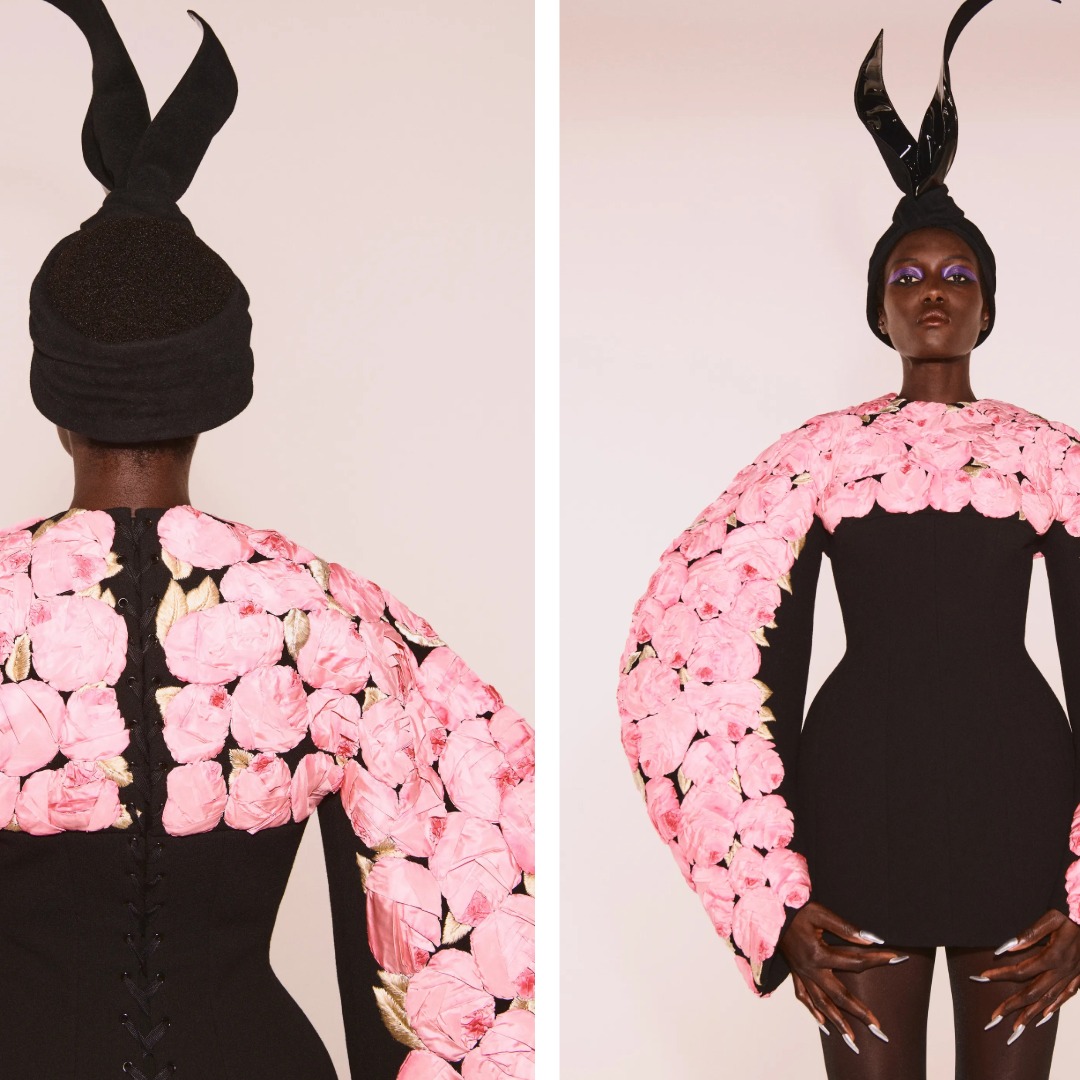
Fashion press described Schiaparelli’s Fall/Winter 2021 couture collection as including a black wool crepe curved-sleeve piece heavily embroidered with dozens of shell-pink silk roses, directly referencing the 1937 Jean Cocteau and Schiaparelli work.
So the rose coat is not only famous because it is old and beautiful. It still gives designers something to work with.
Why this coat still matters
For me, the Schiaparelli rose coat matters because it does not separate idea from making.
Cocteau’s drawing gives the coat its visual intelligence. Schiaparelli gives it the couture context, the body, and the decision to place the main image on the back. Lesage gives it the material reality: gold thread, green thread, tucked pink silk, applied detail, and embroidery precise enough to keep the illusion alive.
And then Doris Castlerosse wore it. That matters too. The coat had a life before the museum.
This is why I do not see it as just a beautiful back view. The back is beautiful, yes, but it is also clever, technical, performative, and slightly mischievous. It uses embroidery not as extra decoration, but as the main reason the garment exists.
Seeing it in real life confirmed why photographs are not enough. A photograph gives you the famous image. The object gives you the decisions: the dark ground, the pink roses, the gold line, the long back, the strange balance between elegance and absurdity.
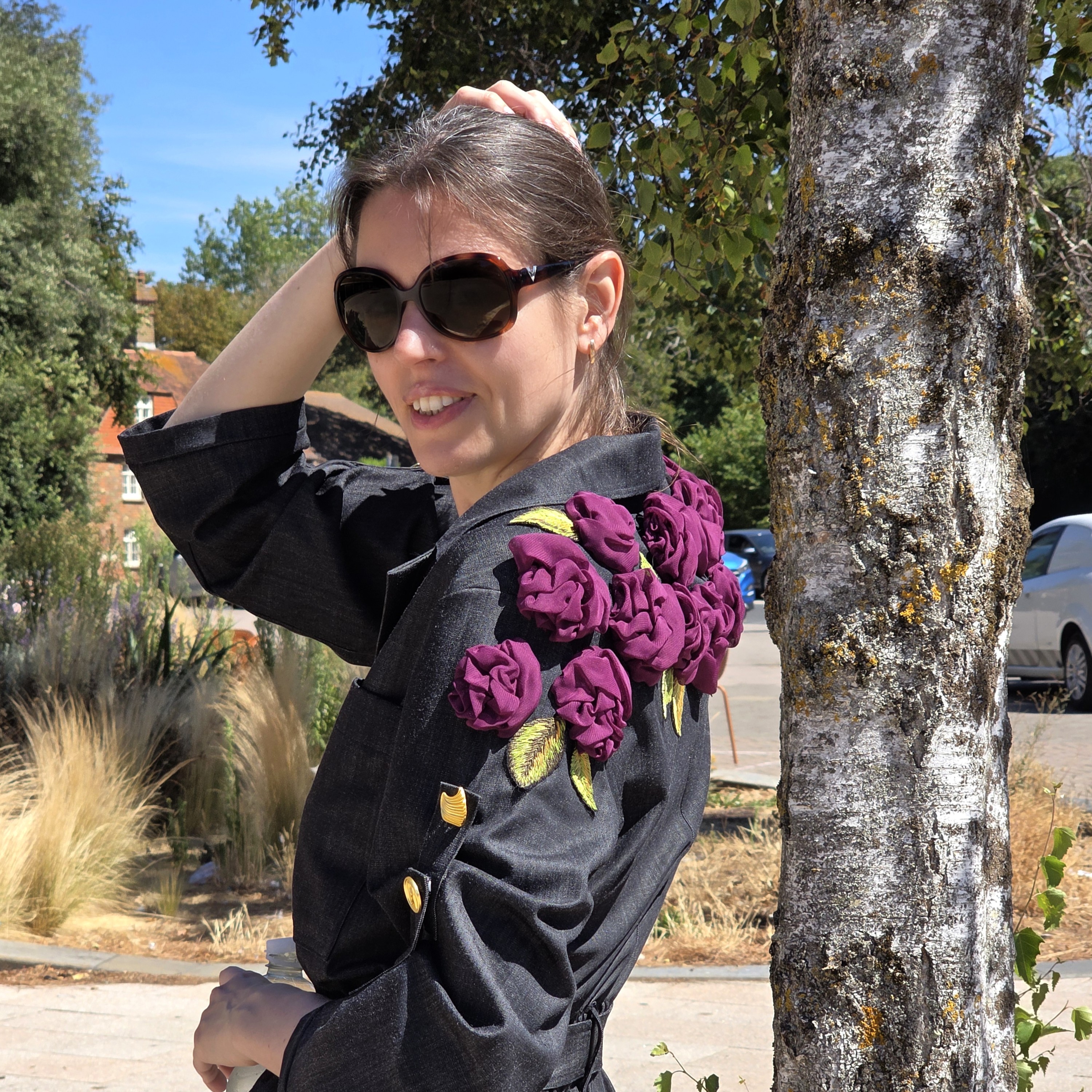
This coat also made me think about how a famous historical reference can be used today without turning into a copy. I do not want to recreate Schiaparelli’s evening coat. I want to take one clear idea from it — roses becoming part of the garment’s identity — and translate it into something connected to my own practice. For me, that means a studio uniform: a useful, comfortable jumpsuit I can wear while working, teaching and filming, but decorated with handmade roses so it also shows what kind of work happens in the studio.
This idea became the starting point for my online course Studio Uniform: A Schiaparelli-Inspired Rose Garment. In the course, I create my own rose-decorated studio garment and show how fabric roses can be used to transform a wearable piece into something more personal and visually memorable.
Join the course: Studio Uniform: A Schiaparelli-Inspired Rose Garmen
For another example of how Schiaparelli’s ideas travelled through later fashion, see my article Broken Mirror Jackets: Schiaparelli (1938–39) and YSL (1978)
Written By
Ksenia Semirova
MA Textiles
An experienced hand embroidery and textile artist based in Hove, UK. Professionally practicing since 2021, mastering various techniques.
Also a fine artist and visual researcher, exhibiting her works across the UK and internationally.
Join my mailing list
Get the latest and greatest updates to your inbox!