New to Luneville embroidery?
Start with the chain stitch—my free visual guide shows you exactly how
Embroidery on knit is often treated as a technical problem. Most advice comes from woven fabric and then gets adapted. That’s where the confusion starts.
In fashion, this question is already answered. Embroidery on knit exists across collections — but not in the way hobby books describe it. The difference is not in the stitches themselves, but in how the material is approached.
The real question is not whether you can embroider on knit, but what you expect the fabric to do once you’ve stitched into it.
Knit vs embroidery — what actually clashes
Knit is built from interlinked loops. It stretches, returns, and shifts under pressure.
Embroidery fixes thread in place. It adds direction and tension.
So every stitch you make does one of three things:
follows the knit
pulls it into a new position
or sits on top of it
Everything else — stitch choice, stabilising, design — comes from this interaction.
How embroidery is actually used on knit in fashion
There isn’t a single method. If you look closely, different designers solve the same problem in completely different ways.
Direct stitching that follows the knit
Seen in Etro and Dior Men collections
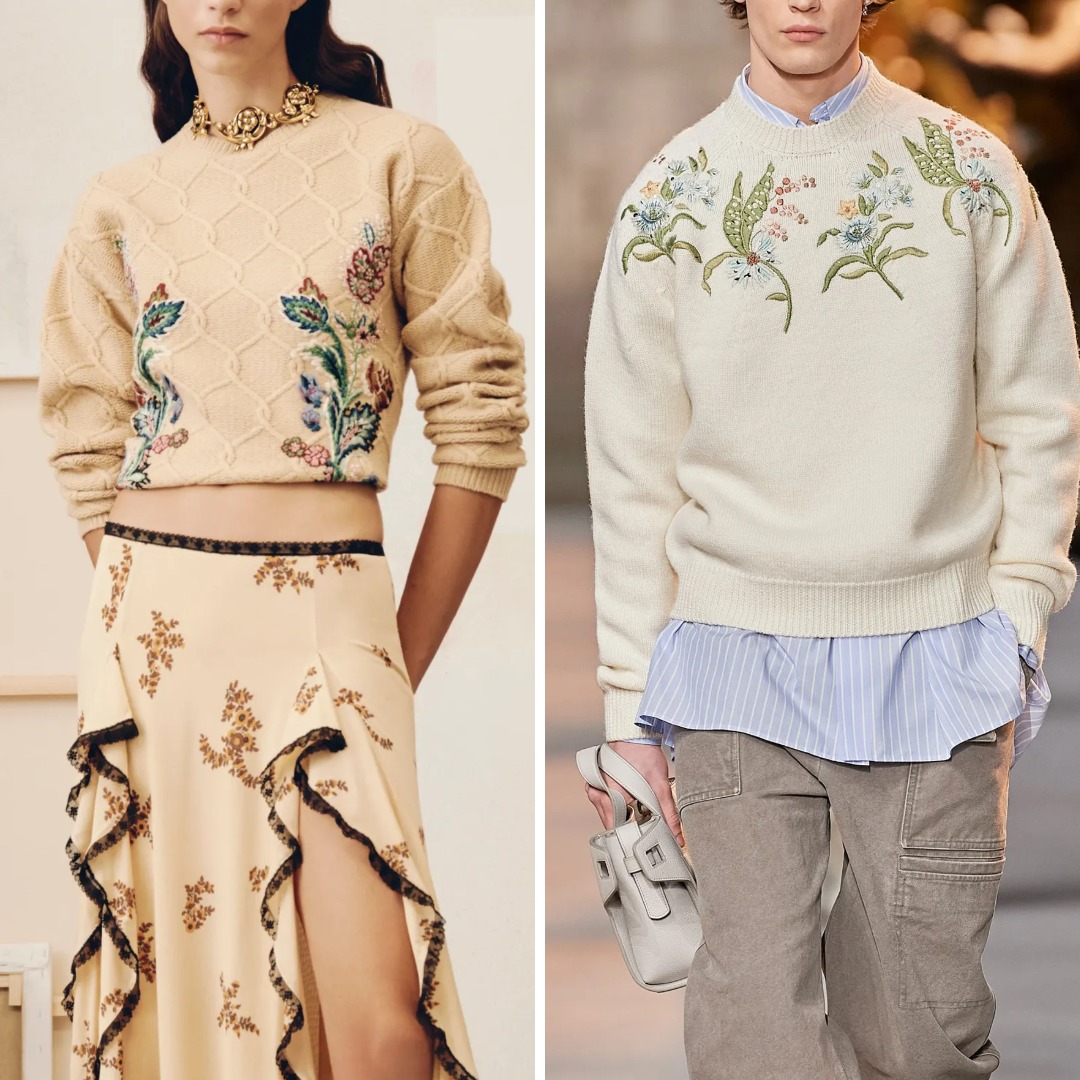
Here, embroidery is placed directly into the knit, but it doesn’t try to reshape it. Motifs are spaced, lines are directional, and there are no compact filled areas.
The fabric keeps its movement because the embroidery doesn’t compete with it.
Built elements applied to knit
Seen in Markarian
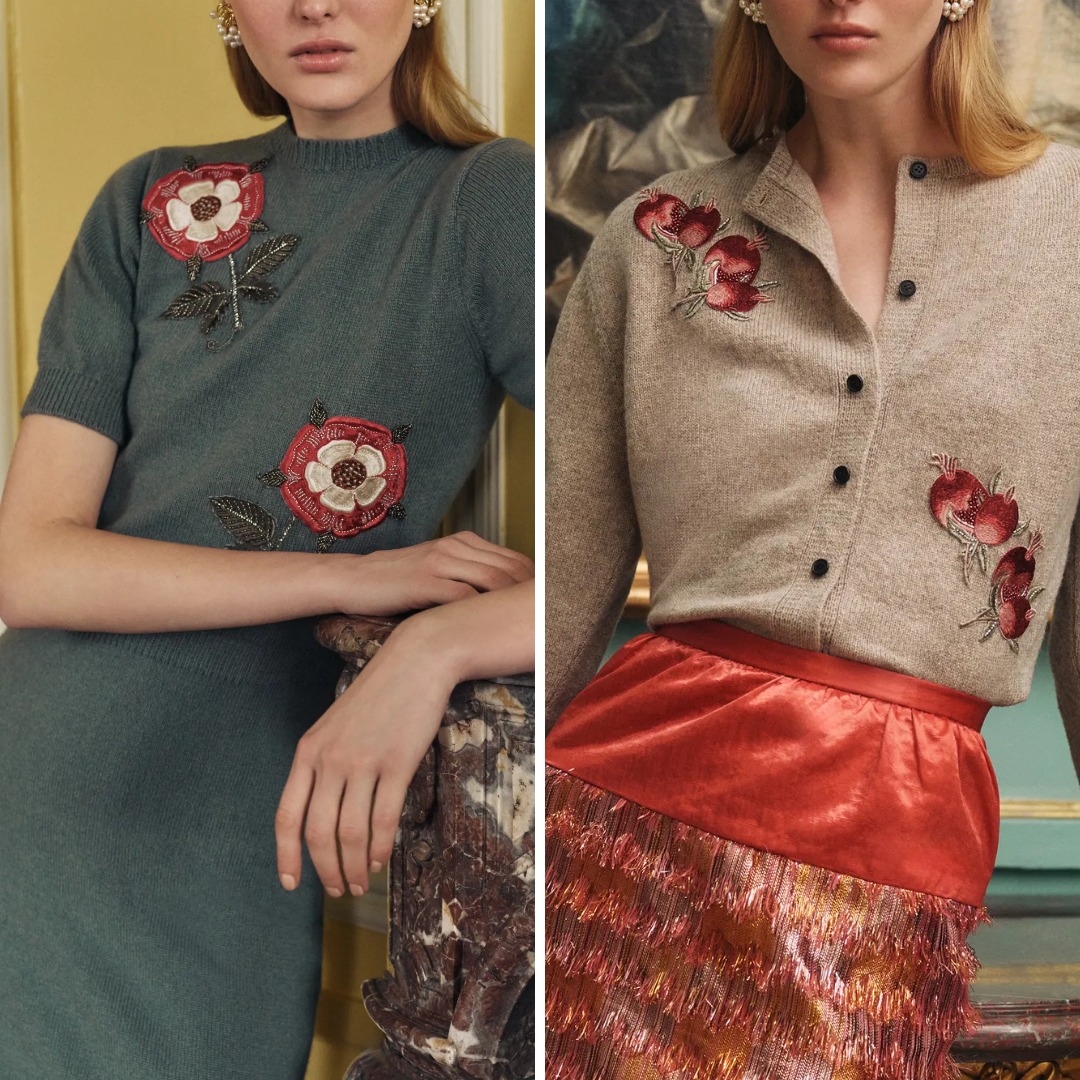
In this case, the embroidery is not dependent on the knit at all. The motif is constructed separately and then attached.
That’s why the edges remain defined. The shape is resolved before it touches the garment.
If the design relies on a clear outline, this approach avoids most of the problems associated with stitching directly into knit.
Knit as a base for embellishment
Seen in Chanel
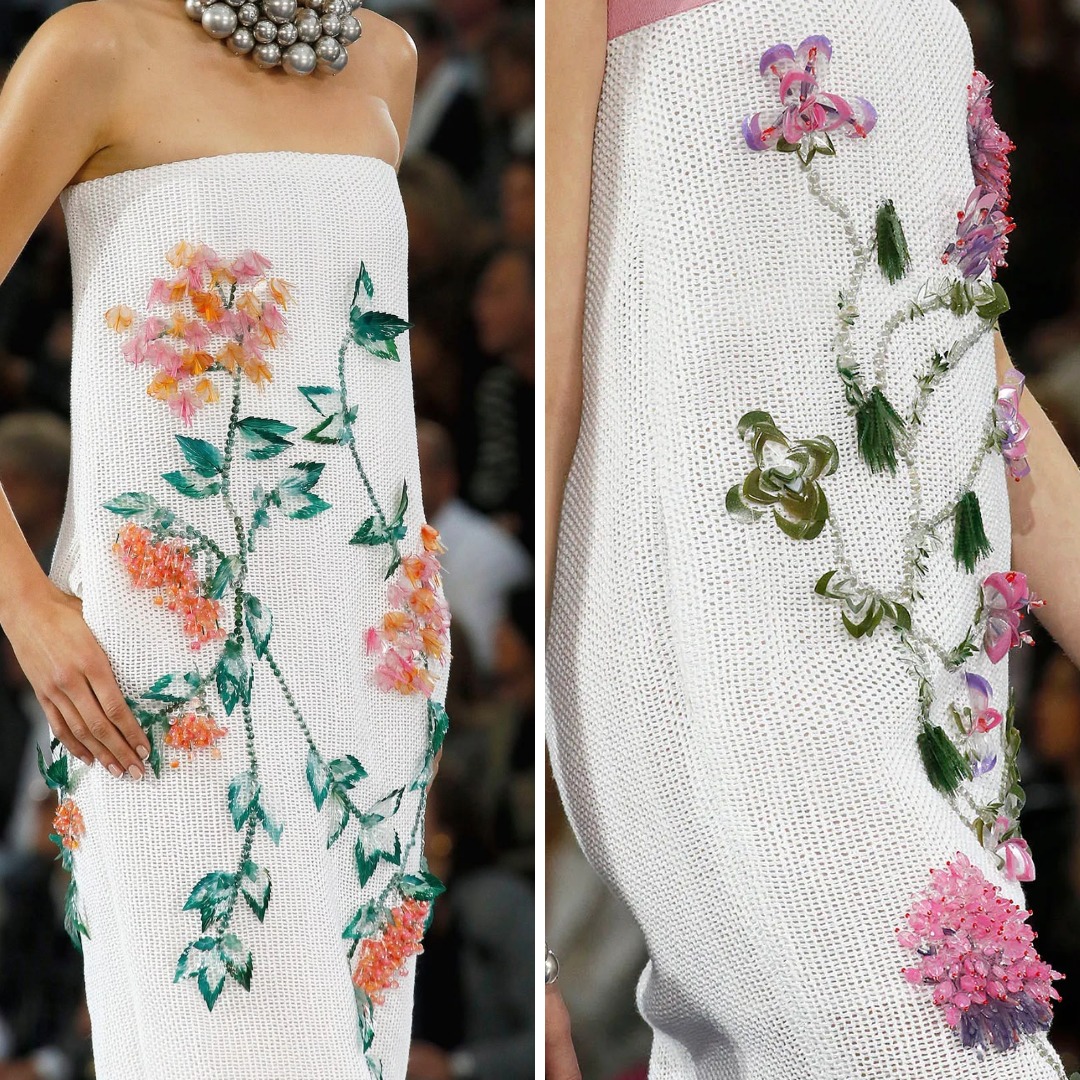
Here, knit carries the decoration rather than shaping it. Beads, flowers, and layered elements sit on top, often in dense arrangements.
In these areas, the fabric no longer behaves like knit. It becomes a support for the embellishment.
This is not avoided — it is used deliberately.
Instability used on purpose
Seen in Christopher Kane
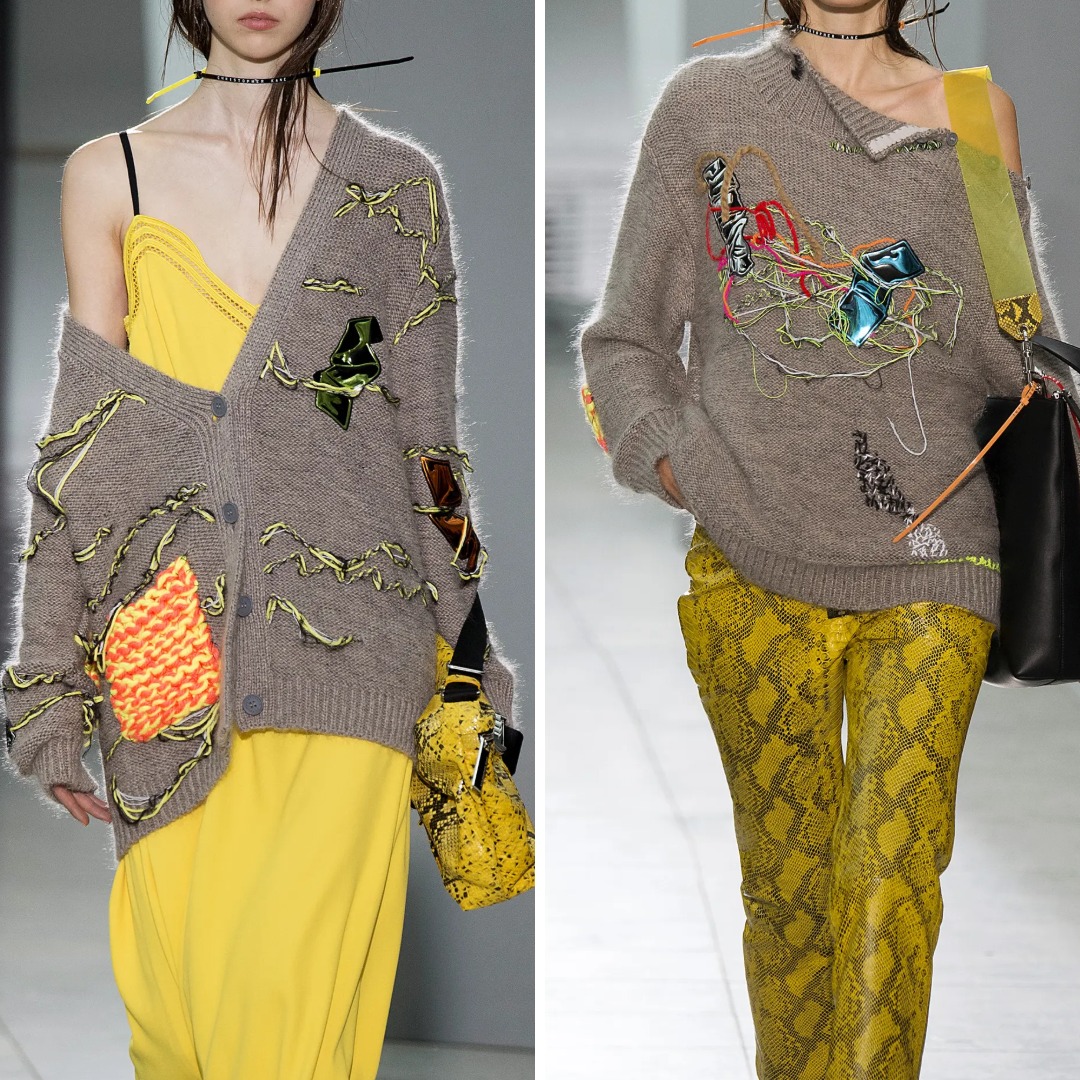
Loose threads, shifting elements, visible construction — nothing is corrected.
What would normally be treated as a mistake becomes the focus. The embroidery reacts to the fabric instead of controlling it.
Stitch behaviour on knit
Listing stitches doesn’t help much. What matters is how they behave once they are in the fabric.
Stitches that follow the knit
(chain-based stitches, loosely worked lines)
These move with the loops instead of forcing them into place. The fabric stays relaxed, and the embroidery becomes part of the surface.
This is why direct embroidery in Etro or Dior doesn’t rely on dense fills. The design is built through spacing and direction, not compact shapes.
The limitation is clear: edges stay open and less defined.
Stitches that sit on the surface
(couching, laid threads)
Here, the thread rests on top and is lightly anchored. The knit underneath is barely disturbed.
This gives a clearer line without pulling the fabric or disappearing into it. If the design needs visibility without changing how the garment behaves, this is one of the most reliable options.
Stitches that pull the fabric
(back stitch, tightly worked stem or split stitch, long directional stitches)
These create continuous tension. Instead of following the knit, they start to shift it.
The fabric tightens along the stitched line. Over a larger area, this turns into visible distortion.
Used in small amounts, this can be controlled. Extended across a surface, it becomes a problem.
Stitches that override the knit
(satin stitch, dense fills, heavy clusters)
These don’t adapt to the fabric. They replace it.
You get a compact, non-flexible area sitting on a flexible base. The knit gathers around it, and movement stops in that section.
In pieces like those from Chanel, this is not avoided. The embroidery takes priority, and the fabric becomes secondary.
Tension — the part most people miss
The same stitch can behave differently depending on how it is worked.
If the thread is pulled tight, the fabric compresses. If it’s too loose, the stitch loses definition. On knit, correct tension is visible: the thread sits on the surface without dragging the loops underneath.
This is not about neatness. It’s about whether the fabric is still relaxed after stitching.
Stabilising knit — what it actually changes
Stabilising is not a technical step. It’s a decision.
If the embroidery is light and follows the fabric, the knit can stay as it is. It keeps its stretch, and the embroidery adapts.
If the design needs more control, support is added. At that point, the embroidered area will no longer behave like the rest of the garment.
Sometimes a surface layer is needed just to keep stitches visible while working, especially on soft knit where threads tend to sink.
Direct stitching vs appliqué
This is where many issues can be avoided altogether.
Direct stitching makes the embroidery part of the knit. It follows the fabric but comes with limitations — edges stay open, and shapes are harder to define.
Appliqué takes a different route. The embroidery is constructed on a stable base and then attached.
That’s why designs like those from Markarian hold their shape. They are not dependent on the knit to define them.
If a design relies on clean edges, it is rarely stitched directly into knit.
When distortion is part of the idea
Not all embroidery aims for stability.
In work like Christopher Kane’s, loose threads and shifting elements are intentional. The fabric moves, the embroidery reacts, and the result is left unresolved.
This approach doesn’t try to correct the behaviour of knit. It uses it.
Designing for knit
The design has to match the material.
What works:
spaced motifs
layered elements instead of solid fills
compositions that don’t depend on sharp edges
What doesn’t:
fully filled stitched areas
tight geometric shapes
dense central designs
These are not stylistic preferences. They come directly from how stitches behave on knit.
Embroidery on knit is not limited. It simply doesn’t follow the same rules as embroidery on woven fabric.
You can work with the knit and keep its movement. Or you can override it and treat it as a base.
Both approaches exist in fashion. The difference is in what you expect the fabric to do once the embroidery is there.
If you want to see more examples, I’ve collected the references from this article and added a few extra pieces in a Pinterest board.
Written By
Ksenia Semirova
MA Textiles
An experienced hand embroidery and textile artist based in Hove, UK. Professionally practicing since 2021, mastering various techniques.
Also a fine artist and visual researcher, exhibiting her works across the UK and internationally.
Join my mailing list
Get the latest and greatest updates to your inbox!